
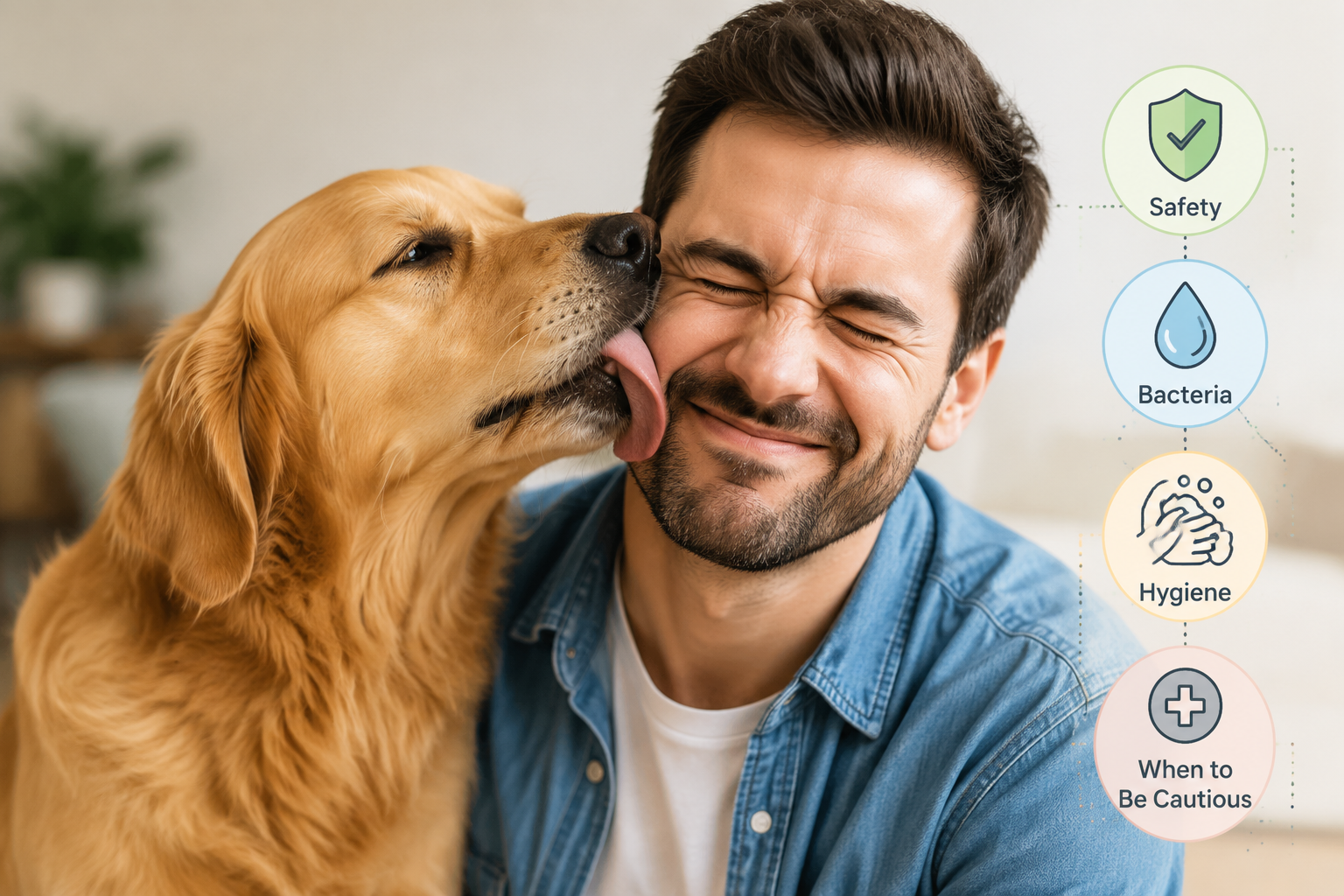

“A dog’s mouth is cleaner than a human’s” — you have probably heard this claim. But is dog saliva actually safe, and what does the science say? Whether your dog licks your face, your child’s hands, or an open wound, understanding what is actually in dog saliva matters for your family’s health.
What Is In Dog Saliva?
Dog saliva is a complex fluid containing:
- Water — the primary component
- Enzymes — including amylase and lysozyme, which have mild antibacterial properties
- Proteins and mucins — which help with food digestion
- Bacteria — hundreds of species, most of which are harmless to healthy humans but some of which are not
- Nitrite compounds — which convert to nitric oxide on skin contact and have mild wound-cleaning properties
The presence of antibacterial enzymes is where the “clean mouth” myth originates. These enzymes do exist — but they do not make a dog’s mouth sterile or even particularly clean.
Is Dog Saliva Safe for Humans?
For the vast majority of healthy adults, occasional contact with dog saliva — a lick on the hand, a face wash from an enthusiastic dog — carries very low risk. The human immune system handles the bacteria in dog saliva without difficulty in most cases.
However, the risk is not zero, and certain situations carry genuine cause for concern.
Bacteria in Dog Saliva That Can Affect Humans
Pasteurella — found in the mouths of most dogs. Can cause skin infections following bites or licks on broken skin. Usually responds to antibiotics but can be serious in immunocompromised people.
Capnocytophaga canimorsus — a bacteria carried by up to 74% of dogs according to the Centers for Disease Control and Prevention (CDC). Harmless to dogs but can cause severe, life-threatening infection in humans — particularly those who are immunocompromised, have had their spleen removed, or have liver disease. Infection typically follows a bite but can occur through saliva contact with broken skin.
Staphylococcus — including some antibiotic-resistant strains. Can be shared between dogs and humans in both directions.
Salmonella and Campylobacter — dogs fed raw diets are more likely to carry these bacteria in their saliva and faeces. Both cause gastrointestinal illness in humans.
Who Is Most at Risk?
Dog saliva poses the highest risk to:
- Immunocompromised individuals — those on chemotherapy, with HIV, or taking immunosuppressant medications
- People who have had their spleen removed (asplenic individuals)
- Elderly people with reduced immune function
- Young children whose immune systems are still developing
- People with open wounds, cuts, or broken skin
For healthy adults, the risk from normal dog-human contact is very low — but awareness matters.
Is It Safe for Dogs to Lick Wounds?
This is one of the most common questions about dog saliva — and the answer is no, despite the persistent myth.
While dog saliva does contain enzymes with mild antibacterial properties, licking wounds:
- Introduces far more bacteria than the enzymes can neutralise
- Keeps the wound moist, which promotes bacterial growth and delays healing
- Can cause the wound to reopen or become further irritated
- In bite wounds, dramatically increases infection risk
The instinct to lick wounds is natural in dogs — but allowing it on human wounds is not advisable, and dogs should be prevented from licking their own wounds for the same reasons (which is why Elizabethan collars are used post-surgery). If your dog has an injury, see our my cat is injured guide — the wound care principles apply to dogs equally.
Can You Catch Disease From Dog Saliva?
Rabies
Rabies can theoretically be transmitted through saliva contact with broken skin or mucous membranes from an infected animal. In the USA, rabies in domestic dogs is extremely rare due to widespread vaccination — but it is not zero. This is why keeping your dog’s rabies vaccination current is legally required in most states. See our upcoming dog rabies vaccine guide for the full schedule.
For the question of whether a dog bite causes rabies, our does a dog bite cause rabies guide covers this in detail.
Ringworm
Despite the name, ringworm is a fungal infection that can be transmitted between dogs and humans through direct contact including licking.
Intestinal Parasites
Roundworms and hookworms can be shed in dog faeces and transmitted to humans — this is more relevant to faecal contact than saliva, but dogs who groom themselves carry trace amounts of faecal bacteria in their saliva.
Safe Practices for Dog Owners
Following basic hygiene practices eliminates most of the risk associated with dog saliva:
- Wash hands after contact with your dog — particularly before eating, after handling their food bowl, and after contact with their mouth area
- Do not allow dogs to lick open wounds, cuts, or broken skin
- Do not allow dogs to lick the faces of very young children or immunocompromised family members
- Keep your dog’s vaccinations current — particularly rabies
- If your dog eats a raw diet, handle their food and bowl with the same hygiene awareness you would use for raw meat — because that is effectively what it is
- See a doctor promptly if you develop redness, swelling, or infection at any site where a dog has licked broken skin, particularly if you are immunocompromised
Dog Saliva and Your Dog’s Own Health
Dog saliva also plays a role in your dog’s own health — and not always a positive one.
Excessive licking of a specific area on their own body is almost always a sign of pain, itching, or anxiety — not normal grooming. Chronic licking of paws, for example, is a hallmark sign of allergies. See our dog skin problems and itching guide for what this behaviour typically indicates.
Dental health affects saliva quality. Dogs with significant dental disease have higher levels of pathogenic bacteria in their saliva. Regular dental care reduces this — see our how to clean dog teeth without brushing guide for practical options.
Dog Saliva — FAQ
Is it okay to let my dog lick my face? For healthy adults with intact skin, occasional face licking carries low risk. The main concern is saliva contact with mucous membranes — eyes, mouth, nose — where bacteria can enter more easily. For young children, elderly people, or immunocompromised individuals, face licking is best avoided.
My dog licked my baby — should I be worried? For a healthy baby with no open skin sores, a single lick is unlikely to cause harm. However, making it a regular habit is not recommended — young children’s immune systems are still developing and they are more susceptible to bacterial infections from dog saliva.
Is dog saliva antibacterial? Partially — dog saliva contains enzymes with mild antibacterial properties. But it also contains hundreds of bacterial species. The antibacterial properties do not neutralise the bacteria present, which is why “a dog’s mouth is cleaner than a human’s” is a myth rather than a medical fact.
Can I get sick from my dog licking my hand? If your skin is intact and you are healthy, the risk is very low. Wash your hands after and before eating. If you have any cuts or broken skin, rinse the area thoroughly with soap and water.
My dog licks everything obsessively — is this normal? Obsessive licking of objects, floors, or surfaces can indicate nausea, anxiety, or a condition called pica (eating non-food items). If your dog’s licking behaviour has increased significantly, mention it to your vet. Our dog anxiety guide covers anxiety-driven repetitive behaviours.
Also read: Dog Skin Problems and Itching | How to Clean Dog Teeth Without Brushing | Dog Anxiety — Signs, Causes and Treatments | My Dog Is Not Eating