


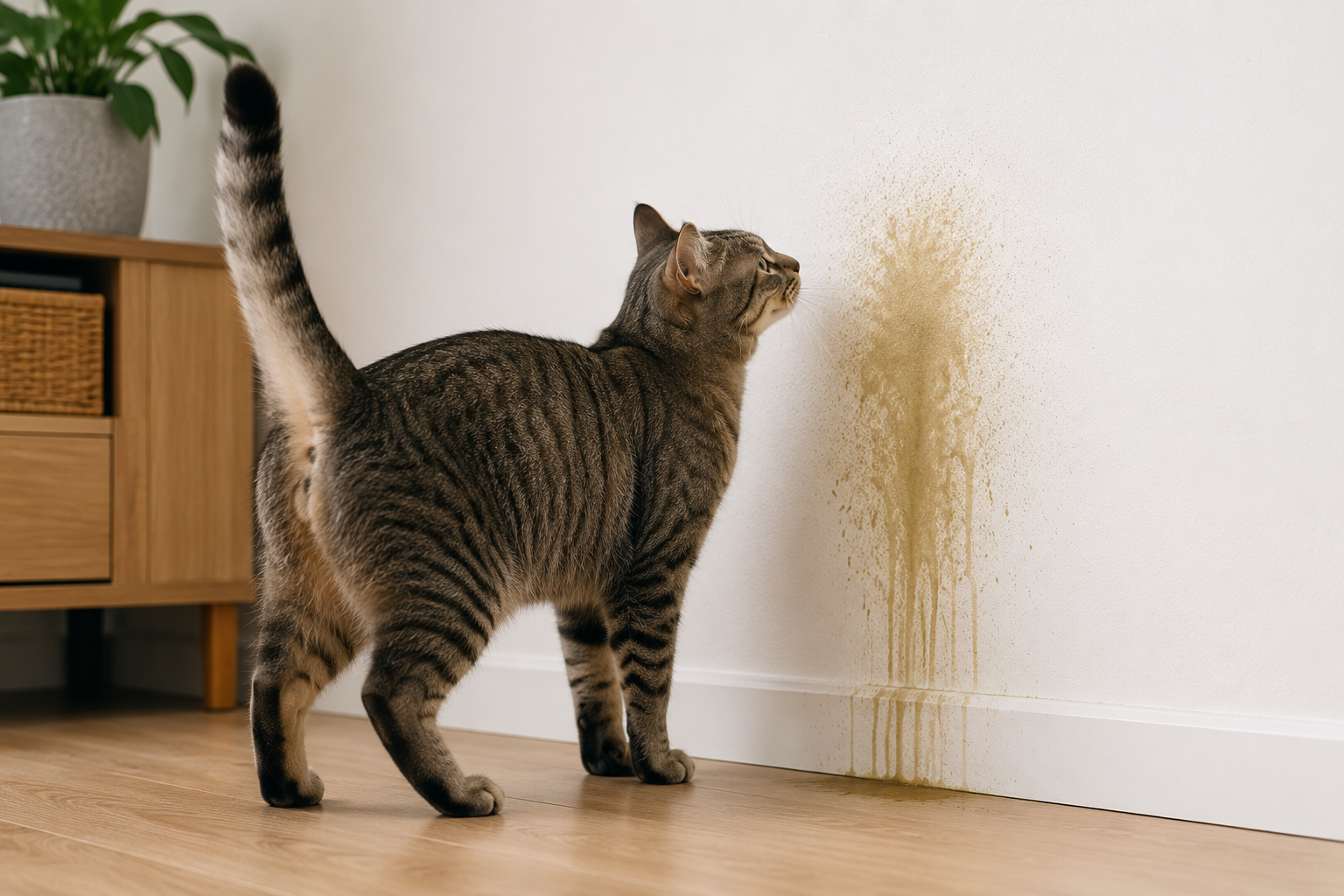

Finding that your male cat is spraying on walls is one of the most frustrating experiences for cat owners — the smell is intense, the behaviour seems random, and it can feel like it comes out of nowhere. But spraying is never random. It is a deliberate communication behaviour with specific causes, and understanding those causes is the first step to solving it.
What Is Spraying? (And How Is It Different From Normal Urination?)
Spraying is not the same as inappropriate urination. Knowing the difference matters because the causes and solutions are different.
Normal urination: Your cat squats and deposits a larger amount of urine in a horizontal surface — usually in the litter box, or outside it if there is a litter box problem.
Spraying: Your cat stands, backs up to a vertical surface (wall, door, furniture leg), holds their tail upright and quivering, and sprays a small amount of urine backward onto the surface. The target is always vertical. The amount is small. The smell is intense.
Spraying is scent marking — your cat is leaving a message, not relieving themselves.
Why Do Male Cats Spray?
Intact Male Hormones
By far the most common cause. Unneutered male cats (toms) are hormonally driven to mark territory with urine. The spray of an intact tom smells significantly stronger than that of a neutered cat because it contains additional hormones and proteins designed to communicate reproductive status to other cats.
The solution: Neutering eliminates spraying in approximately 90% of male cats, particularly when done before the behaviour becomes established. See our should I neuter my cat guide for everything you need to know about the procedure.
Territorial Stress
Even neutered male cats spray when they feel their territory is threatened. Common triggers include:
- A new cat in the household
- Seeing or smelling an outdoor cat through a window or door
- Moving to a new home
- Rearranging furniture or significant changes to the home environment
- A new person or baby in the household
The spray is your cat’s way of reasserting ownership over their space. It is anxiety-driven, not aggressive.
Multi-Cat Household Tension
Cats are not naturally social animals in the way dogs are. In households with multiple cats, social tension — even when it is not obviously visible — is a very common trigger for spraying. One cat may spray in response to feeling subordinate, threatened, or resource-deprived.
Litter Box Issues
Occasionally what appears to be spraying on a vertical surface is actually a cat with a urinary problem urinating while standing. If your cat is also showing signs of discomfort, straining, or visiting the litter box frequently, a urinary tract infection, bladder crystals, or blockage may be involved. These need urgent veterinary attention — see our my cat is sick guide for signs of urinary problems.
Stress and Anxiety
Cats are sensitive to change and routine disruption. Loud building work, a new pet, a house move, or even a change in your work schedule can trigger anxiety-based spraying. The spray is self-soothing as well as territorial — the cat’s own scent provides reassurance in an uncertain environment.
Where Cats Typically Spray
Cats do not spray randomly. They target:
- Doors and windows — particularly where outdoor cats are visible
- New items brought into the home — bags, shoes, boxes
- Walls near entry points — front door, back door
- Areas where other cats (or new people) have been
- Favourite scent-marking locations used previously
How to Stop a Cat From Spraying
Step 1 — Neuter If You Have Not Already
If your cat is intact, neutering is the single most effective intervention. Do this first before attempting any other solution. The behaviour often stops within weeks of the procedure.
Step 2 — Identify and Reduce the Trigger
Look carefully at when and where spraying occurs. Is it always near the front window? A neighbourhood cat is probably visible. Is it near a new piece of furniture? Territorial reassertion. Is it near where your new cat sleeps? Social tension.
Reducing exposure to the trigger reduces spraying:
- Apply window film to lower panes to block the view of outdoor cats
- Use a deterrent near entry points to discourage neighbourhood cats from approaching
- Ensure every cat in a multi-cat household has their own resources — separate food bowls, water bowls, litter boxes, and resting spots
Step 3 — Use a Feline Pheromone Diffuser
Feliway Classic is a synthetic version of the facial pheromone cats deposit when they rub their faces on objects — a scent that signals safety and familiarity. Plug-in diffusers placed in the rooms where spraying occurs reduce anxiety-driven marking in many cats.
Step 4 — Clean Sprayed Areas Thoroughly
Standard household cleaners do not neutralise cat urine odour — they mask it briefly. Your cat can still smell the previous spray site and will return to re-mark it. Use an enzymatic cleaner specifically designed for pet urine, which breaks down the odour molecules rather than covering them.
Step 5 — Reduce Multi-Cat Tension
In multi-cat households, structured reintroduction, separate territories, and ensuring no single cat controls access to resources goes a long way. Our how to introduce a dog to a cat guide covers the principles of managing multi-animal households that apply equally to multi-cat situations.
Step 6 — Consult Your Vet
If spraying persists despite neutering and environmental management, your vet may recommend:
- A full health check to rule out urinary conditions
- Anti-anxiety medication as a short-term bridge while behavioural changes take effect
- Referral to a feline behaviourist
Does Neutering Always Stop Spraying?
Neutering eliminates spraying in around 90% of male cats. The remaining 10% continue to spray due to habit, stress, or territorial factors — but even in these cases, the frequency and intensity of spraying usually reduces significantly after neutering.
Cats neutered before spraying begins are less likely to develop the habit at all. Cats neutered after the behaviour is established may take several weeks to months post-neutering before hormone levels fully drop and behaviour changes.
Why Does My Male Cat Spray on Walls — FAQ
My neutered cat has started spraying suddenly — why? Sudden onset spraying in a previously non-spraying neutered cat almost always indicates a new stressor — a new cat in the neighbourhood, a change in the household, or occasionally a medical issue. Identify what has changed recently and address it. A vet check is sensible to rule out a urinary condition.
Will the spraying smell ever go away on its own? No — cat urine odour does not dissipate effectively without enzymatic treatment. Standard cleaners mask it briefly but the underlying odour compounds remain and continue to attract re-marking. Enzymatic cleaners are the only effective solution.
My female cat is spraying — is this normal? Female cats can spray, though it is far less common than in males. Intact females in heat are the most likely to spray. Spayed females occasionally spray in response to significant stress. The same approach applies — identify the trigger and address it.
Can I punish my cat for spraying? No — punishment is ineffective for spraying and makes the underlying anxiety worse. Cats do not connect punishment to a behaviour that occurred even seconds ago unless you catch them in the exact act, and even then, punishment increases stress rather than reducing it. Address the cause, not the symptom.
Also read: Should I Neuter My Cat? | My Cat Is Sick — Signs and When to See a Vet | Cat Not Using Litter Box | How to Tell If Your Cat Is in Pain