


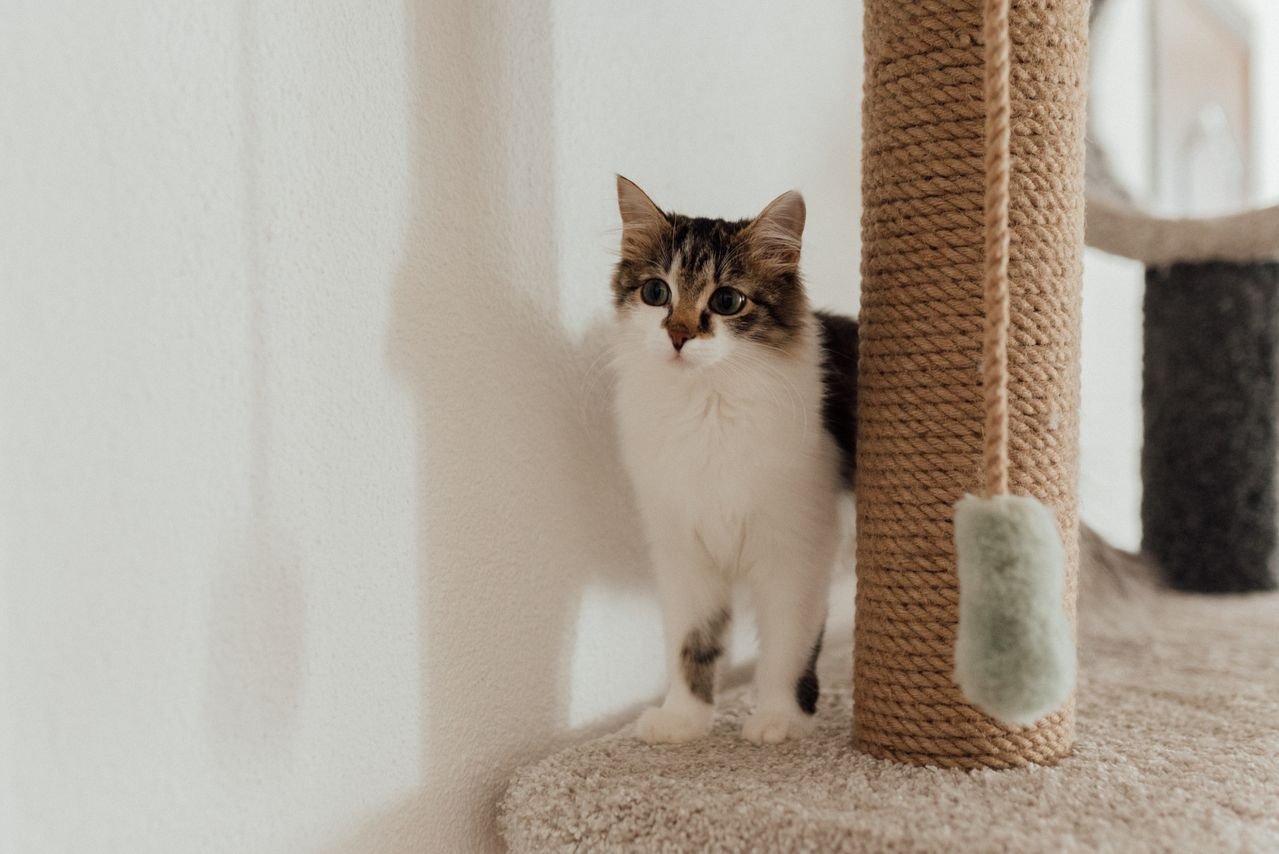

If your sofa corners look like they have been through a shredder, you are living with an under-served scratcher. Cats scratch instinctively — it is not misbehaviour, it is a biological need. The best cat scratching post is not just a piece of pet furniture — it is the thing that redirects your cat’s claws away from your sofa, carpet, and curtains onto something appropriate.
This guide covers why cats scratch, what makes a scratching post work, the best types available, and how to get your cat to actually use it.
Why Cats Scratch — Understanding the Behaviour
Scratching serves four distinct purposes for cats:
Nail maintenance — scratching strips away the outer sheath of the nail, exposing the sharper layer beneath. It is essentially a nail filing system.
Muscle stretching — the full-body stretch involved in scratching works the muscles of the back, shoulders, and legs. Watch your cat scratch — it is a genuine stretch, not just a claw action.
Scent marking — cats have scent glands in their paw pads. Scratching deposits scent on the surface — a territorial signal to other cats.
Visual marking — the scratch marks themselves are a visual signal. Prominent scratch marks communicate presence and territory.
Understanding this helps explain why cats prefer certain spots — they choose locations that are visible, stable, and frequently used. Your sofa arm gets scratched because it ticks all three boxes. The scratching post in the corner of a spare room gets ignored for the same reason.
What Makes a Scratching Post Actually Work
Most scratching posts that go unused share the same problems. Here is what genuinely matters:
Height
The post must be tall enough for your cat to scratch at full stretch — front paws raised, body fully extended. Most cats need a post of at least 32 inches (81cm) — taller for large breeds like Maine Coons or Ragdolls.
Undersized posts are one of the most common reasons cats ignore scratching posts and continue using furniture — they simply cannot get a proper stretch on a short post.
Stability
A post that wobbles or tips when a cat leans into it will be abandoned immediately — and never returned to. The base must be wide and heavy enough to stay completely stationary under full scratching load. This seems obvious but is widely ignored by budget scratching post manufacturers.
Material
Sisal rope or sisal fabric is the best material for most cats — the texture allows claws to catch and drag, which is precisely what cats seek in a scratching surface. Sisal fabric is often preferred over sisal rope as it provides a more consistent scratch surface and does not unravel.
Cardboard — corrugated cardboard scratchers are extremely popular and many cats love them. They are inexpensive, replaceable, and some cats prefer horizontal or angled scratching on cardboard to vertical sisal posts. The limitation is durability — cardboard scratchers need replacing every few weeks.
Carpet — avoid carpet-covered scratching posts. Carpet-covered posts teach your cat that carpet is an acceptable scratching surface — the opposite of what you want if you have carpeted floors.
Wood — natural wood scratchers appeal to some cats, particularly those who scratch tree trunks outdoors. Less common as an indoor product but effective for the right cat.
Location
Place the scratching post next to the furniture your cat currently scratches. This is the most important placement rule. You are not trying to move your cat to a new location — you are providing a better alternative at the exact location they already prefer.
Once your cat is reliably using the post, you can gradually move it (1–2 inches per day) to your preferred location if needed.
Best Cat Scratching Post Types
1. Tall Sisal Post — The Essential Baseline
A tall (32″+), stable sisal-covered post on a wide base. This is the fundamental scratching post every cat home should have — the design that works for the broadest range of cats.
Best for: Cats who scratch vertical surfaces — walls, sofa arms, door frames.
2. Cat Tree with Integrated Scratching Posts
A cat tree combines vertical scratching posts with climbing platforms, hiding spots, and elevated perches — addressing multiple feline needs in a single structure. For households with one or more cats, a quality cat tree is often the most efficient investment.
Best for: Households with multiple cats, active cats who need climbing and jumping outlets, cats with limited outdoor access.
What to look for: Sisal-covered posts (not carpet), a heavy and wide base, platforms at multiple heights, and construction solid enough to not sway when a cat jumps from the top.
3. Horizontal / Flat Cardboard Scratcher
A flat or angled corrugated cardboard scratching pad placed on the floor. Many cats scratch horizontally as well as vertically — particularly when stretching on the floor, or scratching carpet.
Best for: Cats who scratch carpet or flat surfaces, households wanting a low-cost secondary scratcher, supplementing a vertical post.
4. Wall-Mounted Scratching Panel
Sisal panels mounted directly to the wall at scratching height — no base stability issues, no floor space used, and the wall provides the fixed resistance cats prefer. Available in various sizes and increasingly popular as a modern, space-efficient solution.
Best for: Smaller homes, cats who scratch walls or door frames, owners who want a discreet solution that does not dominate a room.
5. Angled Scratcher
An inclined scratching surface at approximately 30–45 degrees — bridging vertical and horizontal scratching angles. Many cats find this angle particularly comfortable and naturally gravitate to it.
Best for: Cats whose preferred scratching angle is unclear, as an alternative to flat cardboard for cats who partially scratch horizontally.
Scratching Post Comparison
| Type | Height | Material | Best For | Price Range |
|---|---|---|---|---|
| Tall sisal post | 32″+ | Sisal | Vertical scratchers | $25–$60 |
| Cat tree | 48–72″ | Sisal + carpet | Multi-cat households | $60–$200 |
| Cardboard scratcher | Flat | Cardboard | Horizontal scratchers | $10–$25 |
| Wall-mounted panel | Variable | Sisal | Space-saving, wall scratchers | $30–$80 |
| Angled scratcher | Inclined | Sisal/cardboard | Mixed scratching angle | $20–$50 |
How to Get Your Cat to Use the Scratching Post
Place it right: Next to the furniture currently being scratched. This is non-negotiable for initial acceptance.
Use catnip: Rub fresh catnip into the sisal surface or use a catnip spray — this attracts most cats to investigate and interact with the post immediately.
Demonstrate scratching: Drag your fingers down the post surface in a scratching motion — many cats mirror this behaviour and begin scratching themselves.
Reward use: Every time your cat uses the post, reward with a treat and praise. Positive reinforcement works effectively for redirecting scratching behaviour.
Protect the furniture being scratched: While introducing the post, temporarily cover the sofa arm or surface being scratched with double-sided tape, aluminium foil, or a plastic cover — cats dislike these textures and will seek an alternative. The scratching post becomes that alternative.
Do not punish scratching furniture: Punishment is ineffective and damages trust. Redirect — do not punish.
Best Cat Scratching Posts — FAQ
My cat ignores their scratching post — why? Most commonly: the post is too short, too wobbly, in the wrong location, or covered in carpet. A tall, stable sisal post placed next to the furniture currently being scratched, with catnip applied, works for the vast majority of cats who have previously ignored posts.
How many scratching posts do I need? At least one per cat, ideally more. Multiple scratching surfaces — vertical and horizontal, in different rooms — give cats appropriate options throughout the home. A cat who only has one post available may scratch furniture in rooms the post does not reach.
Should I trim my cat’s nails instead of using a scratching post? Both — they are complementary, not alternatives. Regular nail trimming reduces damage from scratching; a scratching post satisfies the scratching instinct and prevents furniture damage. Neither alone is sufficient.
My cat scratches the carpet specifically — what helps? A horizontal cardboard scratcher placed on the carpet in the area being scratched addresses this directly. Cats who scratch carpet typically prefer a horizontal surface — a vertical post alone will not redirect this behaviour.
Can I use a scratching post to protect my sofa completely? Yes — with the right post in the right place, most cats shift entirely to the post and leave furniture alone. The key is providing a more appealing option than the sofa, not trying to stop scratching entirely.
Also read: Best Interactive Cat Toys | Why Is My Cat So Aggressive? | How to Get Rid of Cat Hair in Your Home | Cat Not Using Litter Box