
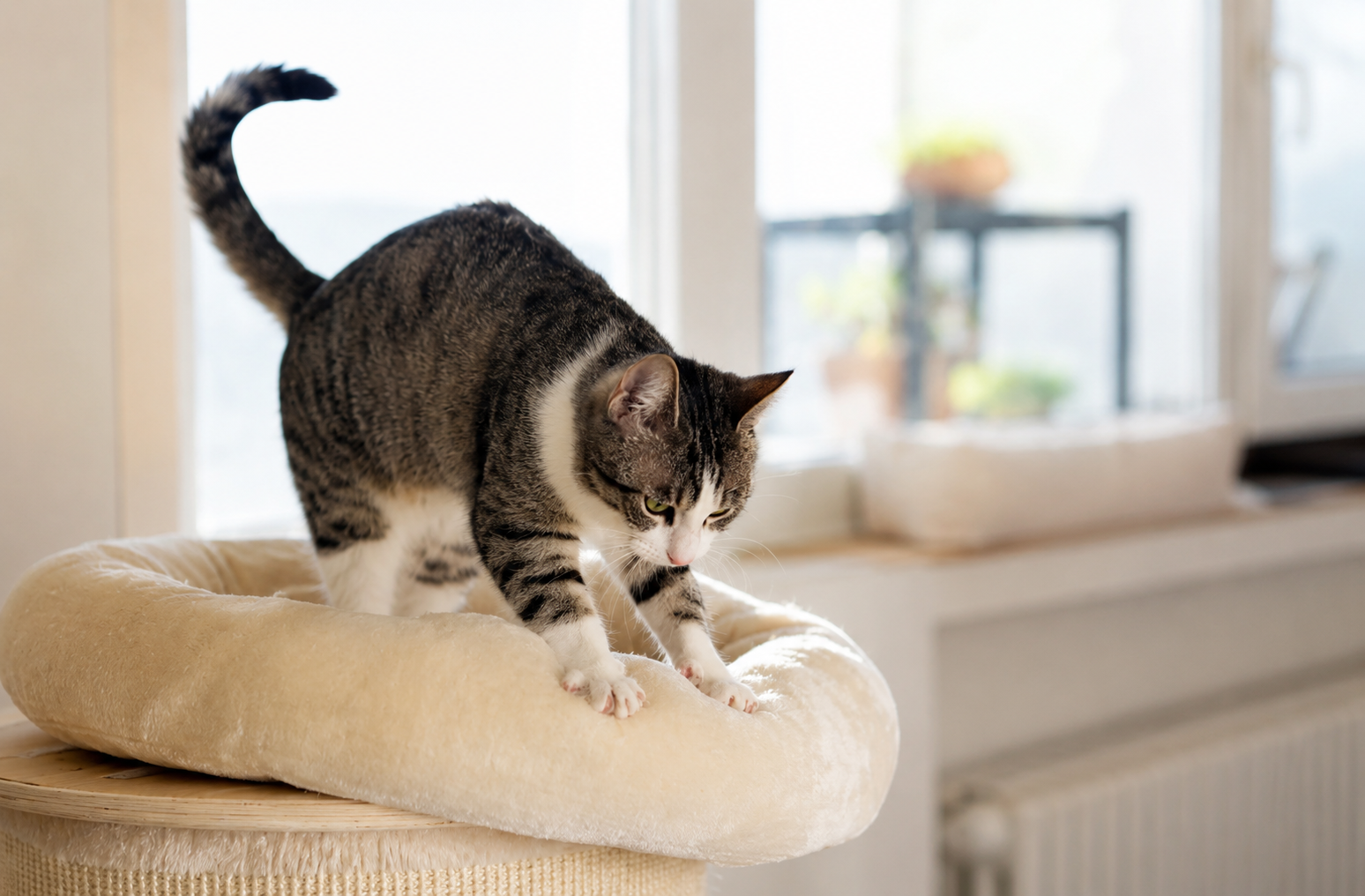

Your cat climbs onto your lap, starts pushing their paws rhythmically into your leg — left, right, left, right — with a look of pure contentment on their face. Sometimes they purr. Sometimes they drool slightly. Sometimes the claws come out and you wince.
This behaviour has a dozen names — making biscuits, making bread, kneading dough, padding, treading — but whatever you call it, you have probably wondered: why does my cat knead?
The answer is rooted in biology, instinct, and the bond between your cat and you. This complete guide explains every reason cats knead, what it means when they knead you specifically, why some cats knead more than others, and what to do if the claws are becoming a problem.
What Is Cat Kneading?
Kneading is the rhythmic pushing motion cats make with their front paws — alternating left and right — typically against a soft surface. The action resembles a baker kneading dough, which is where “making biscuits” comes from.
Most cats knead with their front two paws, though some use all four. Many cats extend and retract their claws with each push — which feels wonderful when they are on a blanket and less wonderful when they are on your thighs.
Kneading is almost always accompanied by a relaxed, contented expression — soft eyes, slow blinking, sometimes purring. It is one of the most instinctive and fundamental behaviours in domestic cats.
The Real Reason Cats Knead — It Starts at Birth
The primary reason cats knead goes back to the very first days of their life.
Newborn kittens knead their mother’s mammary glands to stimulate milk flow. The rhythmic pushing action activates milk letdown — without kneading, the kitten cannot nurse effectively. This behaviour is hardwired from birth as a survival mechanism.
As kittens grow and are weaned, they no longer need to knead for milk — but the behaviour persists. This is because kneading became deeply associated with warmth, comfort, safety, nourishment, and the presence of the mother. The action itself triggers the release of feel-good neurochemicals — it is self-soothing in the most fundamental sense.
An adult cat kneading is essentially returning to that foundational state of comfort and security. They are not aware they are mimicking nursing behaviour — they simply feel good when they knead, because their brain has been wired since birth to associate that motion with everything safe and satisfying.
This is why kneading is almost always a sign that your cat is content, relaxed, and feeling secure in their environment.
7 Reasons Why Cats Knead
Reason 1 — Contentment and Happiness
The most common reason by far. A cat that kneads — especially while purring — is a cat in a state of deep contentment. The behaviour signals that they feel safe, relaxed, and comfortable. If your cat kneads on you or near you, it is one of the most genuine expressions of feline happiness you will ever see.
Think of it as your cat’s version of a satisfied sigh — a completely involuntary expression of wellbeing.
Reason 2 — Showing Affection Toward You
When your cat kneads specifically on you — your lap, your legs, your chest, your stomach — they are expressing affection and trust. You are the soft, warm, safe surface they have chosen. You have been selected as their person.
Cats do not knead strangers or surfaces they feel anxious around. The act of kneading on you is a genuine expression of the bond your cat feels with you — the equivalent of a cat saying “I love you” in feline terms.
Reason 3 — Scent Marking Their Territory
Cats have scent glands in their paw pads. When they knead a surface — a blanket, a pillow, you — they are depositing their scent onto it. This is a form of territorial marking.
This is not aggressive marking — it is the gentle, affectionate kind. A cat kneading you is partly saying “this person is mine.” The same applies to favourite blankets and sleeping spots — repeated kneading leaves a familiar scent that makes the spot feel like theirs, which in turn makes it feel safer and more comfortable.
Reason 4 — Preparing a Sleeping Spot
Before lying down, many cats knead the surface they are about to sleep on — turning in circles and pushing with their paws. This behaviour likely originates from wild ancestors who would pat down grass, leaves, and vegetation to create a comfortable, flat sleeping spot — also checking for insects or snakes in the bedding.
If your cat kneads their bed, your blanket, or a cushion before settling down to sleep, this is almost certainly what is happening.
Reason 5 — Stress Relief and Self-Soothing
Because kneading is neurologically linked to the comfort of nursing, adult cats sometimes knead when they are anxious or stressed — using the familiar motion to self-soothe. A cat that is nervous in a new environment, unsettled by a change in routine, or anxious before a vet visit may knead more than usual.
This does not mean something is wrong — it means the cat is using one of their most fundamental coping mechanisms to manage an uncomfortable feeling. If kneading is accompanied by other anxiety signs — hiding, over-grooming, reduced appetite — it is worth investigating the source of stress. For more on cat anxiety, read our guide on how to tell if your cat is in pain which covers anxiety signals in detail.
Reason 6 — Stretching and Physical Comfort
The kneading motion engages the muscles of the paws, lower legs, and shoulders in a repetitive, rhythmic contraction. For cats that spend a lot of time curled in one position — particularly older cats — this gentle flexion may serve a stretching and circulation function alongside the emotional comfort it provides.
Some cats knead specifically when they first wake up or after a long rest, in the same way a person might stretch upon waking.
Reason 7 — Oestrus Behaviour in Unspayed Females
Unspayed female cats in heat knead more frequently and intensely than usual, often combined with vocalisation, rolling, and other reproductive behaviours. If your female cat has suddenly started kneading more and you notice other signs of being in heat — loud vocalisation, restlessness, and elevated back end when touched — this is likely the cause.
Spaying resolves this entirely and eliminates the heat cycle. Spayed females return to normal, calm kneading behaviour associated with contentment.
Why Does My Cat Knead Me Specifically?
This is the question most owners really want answered — and the answer is genuinely heartwarming.
Your cat kneads you because you are their safe person. You are warm, soft, and associated with positive experiences — food, play, affection, shelter. When your cat kneads you, they are placing you in the same psychological category as the warmth and security of their mother. That is a remarkable level of trust and affection from an animal that spent millennia as a solitary hunter.
Cats knead the people they feel most bonded to. If you are the primary caregiver — the one who feeds, plays with, and provides comfort — you are almost certainly the one they knead most. Being selected for kneading is a compliment of the highest feline order.
Why Does My Cat Knead My Stomach?
The stomach is warm, soft, and rises and falls rhythmically with breathing — which mimics the sensation of a mother’s body for the cat. Many cats are particularly drawn to kneading the stomach or chest, where they can feel the warmth and gentle movement of breathing.
Some owners notice their cat kneads their stomach more during pregnancy — the warmth and scent changes of pregnancy are detectable to a cat’s highly sensitive nose, and the increased warmth of the abdomen may attract them.
Why Does My Cat Knead My Hair?
Hair is warm, soft, and carries your personal scent very strongly — which is exactly what attracts a cat to it. Cats that knead hair often also lick it, combining the kneading behaviour with social grooming (allogrooming), which is another expression of affection and bonding.
Why Do Cats Knead Blankets?
Blankets are the perfect kneading object — soft, warm, and increasingly scented with the cat’s own smell the more they use them. Blanket kneading is a natural extension of the same comfort-seeking behaviour, and some cats have particular favourite blankets they return to repeatedly.
Fleece and soft fabric blankets are especially popular — their texture is similar to a mother cat’s fur, which may be why so many cats are particularly drawn to them.
Some cats also knead and then suckle blankets — gently taking fabric into their mouth while kneading. This is an extension of the nursing behaviour and is more common in cats that were weaned early. It is generally harmless unless the cat is consuming fabric, which would warrant veterinary discussion.
Why Do Some Cats Knead More Than Others?
Not all cats knead with the same frequency or intensity — and some cats never knead at all. This variation is completely normal and does not indicate a problem.
Early weaning: Cats weaned from their mothers earlier than the recommended 8–10 weeks often knead more intensely and more frequently as adults. The behaviour was interrupted before it naturally diminished, so it remains strong.
Personality and temperament: Some cats are simply more demonstrative than others. A naturally affectionate, people-oriented cat will knead more than an independent, less touch-oriented cat.
Breed tendencies: Certain breeds — Ragdolls, Burmese, Siamese, Maine Coons — are known for being particularly affectionate and are often more frequent kneaders than more independent breeds.
Individual variation: Just as some humans are more tactile and expressive than others, some cats simply knead more. A cat that never kneads is not unhappy — they express contentment differently.
My cat stopped kneading: A cat that previously kneaded regularly and has suddenly stopped may be experiencing pain — particularly if the change coincides with other behavioural changes. Paw pain, arthritis, or general illness can reduce kneading. A vet check is appropriate if the change is sudden.
Is My Cat Happy When They Knead?
In almost all cases, yes. Kneading is one of the most reliable indicators of feline contentment. A cat that kneads is a cat that feels safe, comfortable, and emotionally secure.
The combination of kneading and purring together is one of the strongest signals of deep cat happiness available. If your cat kneads on you while purring, you can be confident that they are experiencing something very close to what we would call joy.
The only exception is stress-related kneading — which tends to occur alongside other anxiety signals and in the context of an obvious stressor (new environment, new pet, vet visit). Even stress-related kneading is not distressing for the cat — it is a coping mechanism that helps them feel better.
Why Does My Cat Drool When Kneading?
Some cats drool slightly when kneading — which can be surprising the first time you notice it. This is completely normal and is related to the same nursing-memory association.
When kittens nurse, suckling triggers salivation as part of the feeding response. For cats that retain strong nursing behaviour associations, kneading can trigger the same salivation response — even as adults. It simply means the cat is in an extremely relaxed, deeply contented state.
Drooling during kneading is more common in cats weaned early and in cats that are particularly affectionate. It is not a dental or health concern unless drooling occurs at other times when the cat is not kneading or relaxed.
What Does It Mean When a Cat Kneads With Claws Out?
Most cats extend their claws during kneading — this is the natural motion that mimics the action on their mother’s mammary glands. Whether the claws are extended or not varies by individual cat and by surface.
Many cats retract their claws more when kneading on skin versus kneading on fabric — but not all. A cat kneading with claws extended is not being aggressive — they are simply performing the behaviour in its natural form without the social modification of claw retraction.
How to Manage Kneading With Claws — Without Discouraging the Behaviour
If your cat’s kneading is painful due to claws, there are several ways to manage it without discouraging the behaviour itself — because discouraging kneading sends the wrong message to a cat expressing contentment and affection.
Place a thick blanket on your lap. The simplest and most effective solution. Keep a folded blanket on your lap that the cat can knead through — protecting your legs while allowing the behaviour to continue.
Redirect to a kneading-specific surface. Some cats learn to knead a dedicated blanket or pillow rather than your body. Keep a favoured soft blanket nearby and gently move the cat to it when they start kneading — reward when they continue on the blanket.
Trim the claws regularly. Regular nail trimming significantly reduces the discomfort of kneading with claws. Every 2–3 weeks is appropriate for most cats. For guidance on nail trimming, read our guide on how to trim cat nails without getting scratched.
Soft nail caps. Vinyl nail caps (such as Soft Paws) cover the claw tips and prevent scratching without interfering with claw extension. Applied at home or by a vet, they last 4–6 weeks before the cat naturally sheds them.
Never punish kneading. Never push your cat away, raise your voice, or punish them for kneading. This confuses and distresses a cat who is expressing affection and contentment. Manage the discomfort — do not discourage the behaviour.
Do Wild Cats Knead?
Yes — kneading appears in wild cat species including lions, tigers, and leopards, primarily in the context of comfort, maternal bonding, and preparing sleeping areas. This confirms that kneading is an ancient, deeply instinctive feline behaviour rather than something exclusive to domestic cats.
Interestingly, adult wild cats appear to knead less frequently than domestic cats — possibly because domestic cats retain more juvenile behaviours into adulthood (a phenomenon called neoteny), partly as a result of living in close proximity to humans who provide the security and care that would otherwise be reserved for a mother.
Frequently Asked Questions
Why does my cat knead me? Your cat kneads you because you are their safe, trusted person. Kneading is rooted in kitten nursing behaviour and is associated with warmth, comfort, and security. When your cat kneads you specifically, they are expressing affection and trust — placing you in the same category as everything safe and comforting in their world.
Is kneading a sign my cat is happy? Yes — in almost all cases, kneading is one of the most reliable signs of feline contentment. A cat that kneads — especially while purring — is expressing deep comfort and wellbeing. It is one of the most positive things a cat can do.
Why do cats knead blankets? Blankets are soft, warm, and accumulate the cat’s own scent — making them ideal kneading targets. The texture of soft fabrics like fleece resembles a mother cat’s fur, which may reinforce the comfort association. Many cats have specific favourite blankets they return to for kneading sessions.
Why does my cat knead and then bite the blanket? Combining kneading with gentle biting of the fabric is an extension of nursing behaviour. The cat is essentially mimicking the full nursing action — kneading and suckling simultaneously. It is harmless unless the cat is consuming fabric, which would need veterinary advice.
Why do some cats not knead? Some cats simply do not knead — or knead very rarely. This is completely normal and does not indicate unhappiness. Cats express contentment in different ways — slow blinking, headbutting, following their owner around, and sleeping nearby are all alternative expressions of the same bond.
How do I stop my cat kneading me with claws? The most effective approach is placing a thick folded blanket on your lap for them to knead through, trimming their claws regularly every 2–3 weeks, or using soft vinyl nail caps. Never punish or discourage kneading — manage the discomfort while allowing the affectionate behaviour to continue.
Conclusion
Why does my cat knead? Because you make them feel exactly as safe, warm, and loved as their mother did when they were days old. That is the real reason — and it is one of the most endearing things about living with a cat.
Kneading is instinct, affection, contentment, and trust expressed in the most ancient, fundamental feline way. When your cat climbs onto your lap and starts making biscuits, the right response is to appreciate what it means — and maybe put a blanket down first.
For more cat behaviour and care advice, read our guides on why does my cat stare at me, why does my cat lick me, and how to tell if your cat is in pain.
If your cat has suddenly stopped kneading after a long history of the behaviour, particularly alongside other behavioural changes, a vet check is worthwhile — sudden changes in established behaviours can occasionally signal underlying health issues.
Also read: Why Does My Cat Stare at Me? | Why Does My Cat Lick Me? | How to Trim Cat Nails Without Getting Scratched | How to Tell If Your Cat Is in Pain | How Long Do Cats Live?