


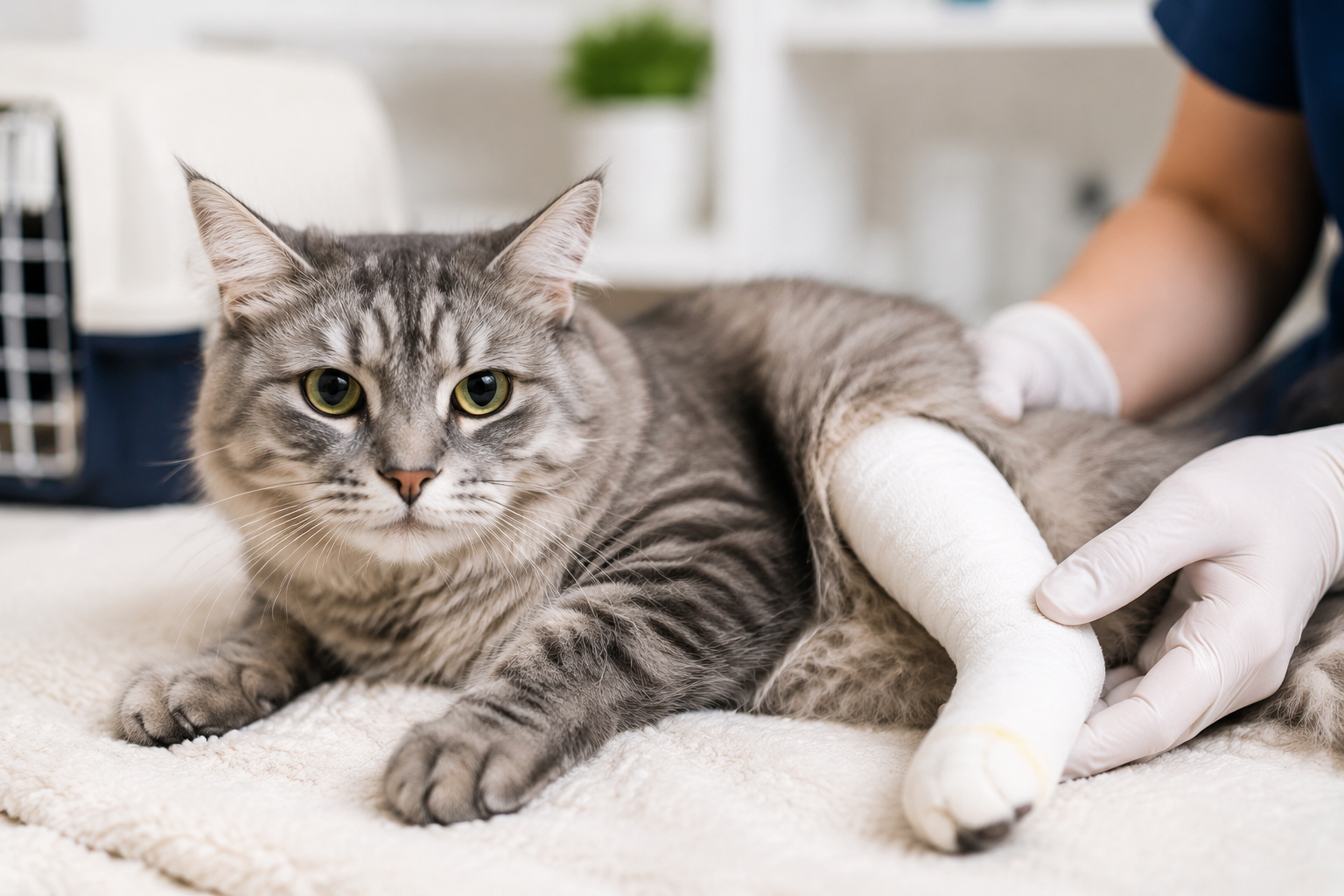

A broken leg in a cat is a genuine emergency. Whether your cat fell from a height, was hit by a vehicle, or came home from outside unable to bear weight, acting quickly and calmly is what matters most in the first few minutes.
This guide covers how to tell if your cat’s leg is broken, what to do before you reach the vet, and what treatment looks like.
Signs Your Cat’s Leg May Be Broken
Cats hide pain instinctively, but a broken bone is difficult to conceal completely. Look for:
- Not bearing weight on one leg — holding it up completely while walking
- Obvious deformity — the limb looks bent, twisted, or at an unnatural angle
- Swelling around the injury site, developing within minutes to hours
- Crying or vocalising when the leg is touched or when trying to move
- Dragging a limb rather than lifting it
- Visible bone in open (compound) fractures — this is a serious emergency
- Extreme reluctance to move — your cat stays completely still to avoid pain
Types of Fractures in Cats
Closed fracture — the bone is broken but the skin is intact. The most common type.
Open (compound) fracture — the broken bone has pierced through the skin. High risk of infection. Requires immediate emergency treatment.
Greenstick fracture — an incomplete break, more common in kittens whose bones are still developing. Less severe but still requires veterinary care.
Growth plate fracture — affects the growing ends of bones in kittens. Needs careful treatment to prevent long-term growth problems.
What to Do Immediately
Do NOT:
- Attempt to straighten or splint the leg yourself — this causes additional pain and can worsen the injury
- Let your cat walk or jump — movement risks further displacement of the fracture
- Give any human pain medication — paracetamol, ibuprofen, and aspirin are all toxic to cats
- Squeeze or probe the injury site
Do:
- Confine your cat immediately — place them in a carrier or a small, quiet box lined with a soft towel
- If your cat won’t go into a carrier willingly, wrap them gently in a thick towel (a burrito wrap) — see our cat injury first aid guide for the safe handling technique
- For an open fracture with bleeding — apply very gentle pressure with a clean cloth around (not on) the bone, and cover loosely with a clean damp cloth
- Keep your cat warm — injured cats can go into shock quickly
- Call your vet immediately and go directly — do not wait to see if it improves
Emergency Transport Essential:
To prevent your cat from thrashing and worsening a fracture during transport, always keep a sturdy, top-loading carrier on hand.
🔗 Recommended Product: Top-Loading Hard Shell Pet Carrier on Amazon.
Getting to the Vet Safely
Transport is critical with a suspected fracture:
- Keep the carrier level and stable in the car — avoid sudden braking
- If you do not have a carrier, slide your cat onto a flat rigid surface (clipboard, small board) keeping the body as straight as possible
- Cover with a light blanket for warmth and to reduce visual stimulation — a covered, dark space is calming for a frightened cat
- Call ahead so your vet is ready when you arrive
How Vets Diagnose and Treat a Broken Leg
Diagnosis
Your vet will perform a physical examination and take X-rays to confirm the fracture, identify the type and location, and plan treatment.
Treatment Options
Splinting or casting — suitable for certain fractures, particularly in the lower leg, where the bone can be stabilised without surgery.
Surgical repair (ORIF) — Open Reduction Internal Fixation uses metal pins, plates, or screws to hold the bone in correct alignment while it heals. This is the most common treatment for significant fractures in cats. Recovery is generally very good.
External fixation — metal pins placed through the skin and connected to an external frame, used for complex or open fractures.
Amputation — in severe cases where the bone and surrounding tissue are too damaged to repair, amputation is sometimes the kindest and most practical solution. Cats adapt remarkably well to life on three legs.
Recovery — What to Expect
Recovery from a broken leg typically takes 6–12 weeks depending on the fracture type, treatment method, and your cat’s age.
Essential Cat Recovery Supplies (Amazon Picks)
| Recovery Need | Recommended Product | Why It Helps |
| Strict Confinement | Collapsible Soft Mesh Pet Playpen / Recovery Crate | Keeps your cat safe and prevents jumping during the 6–12 week recovery phase. |
| Cone Alternative | Soft Inflatable E-Collar Recovery Doughnut | Much more comfortable than stiff plastic cones for eating and sleeping with a cast. |
| Litter Box Access | Low-Entry Shallow Litter Box for Injured Cats | Allows your cat to step into the litter tray without lifting their cast or leg high. |
| Grooming Support | Unscented Pet Wipes & Waterless Shampoo | Cats cannot bathe with a cast on; wipes keep them clean and odor-free. |
| Joint & Bone Care | Vet-Recommended Liquid Calcium & Glucosamine Drops | Supports bone density and joint healing during recovery (consult your vet before use). |
- Strict cage rest is essential — your cat must not jump, climb, or run
- An Elizabethan collar (cone) prevents your cat from licking or interfering with the repair site
- Pain medication will be prescribed — give exactly as directed
- Follow-up X-rays check that healing is progressing correctly
- Kittens heal faster than adult or senior cats
Cost: Veterinary treatment for a cat broken leg typically ranges from $200–$2,000+ depending on the fracture severity, treatment required, and your location. This is where good pet insurance matters enormously — see our best pet insurance guide for options that cover cats as well as dogs.
Preventing Broken Legs in Cats
- Keep windows screened — falls from open windows are a leading cause of fractures in urban cats
- Supervise outdoor access where possible — road accidents and cat fights are common causes
- Keep cats indoors at night when road traffic risk is highest
- Ensure balconies are cat-proofed with appropriate netting
My Cat’s Leg Is Broken — FAQ
Can a cat’s broken leg heal on its own? No. An untreated fracture causes ongoing pain, can heal in a deformed position causing permanent lameness, and risks serious infection in open fractures. All suspected fractures need veterinary assessment and treatment.
How do I know if it’s broken or just sprained? You cannot reliably tell the difference at home — both cause limping, pain, and swelling. Any cat not bearing weight on a limb for more than a few hours needs veterinary assessment. X-rays are the only way to confirm a fracture.
My cat is in pain — can I give them anything before the vet? No human pain medication is safe for cats. Do not give anything. Keep your cat calm, warm, and still, and get to the vet as quickly as possible.
Will my cat walk normally again after a broken leg? The majority of cats treated promptly and appropriately recover full or near-full function. Kittens in particular heal very well. Early treatment significantly improves long-term outcomes.
My cat seems fine after a fall but I am not sure — do I still go to the vet? Yes. Cats can appear relatively normal immediately after a serious fall before deteriorating. Internal injuries are not always visible. Any fall from a significant height warrants same-day veterinary assessment.
Also read: My Cat Is Injured — First Aid Guide | My Cat Is Sick — Signs and When to See a Vet | How to Tell If Your Cat Is in Pain | Best Pet Insurance for Dogs and Cats