


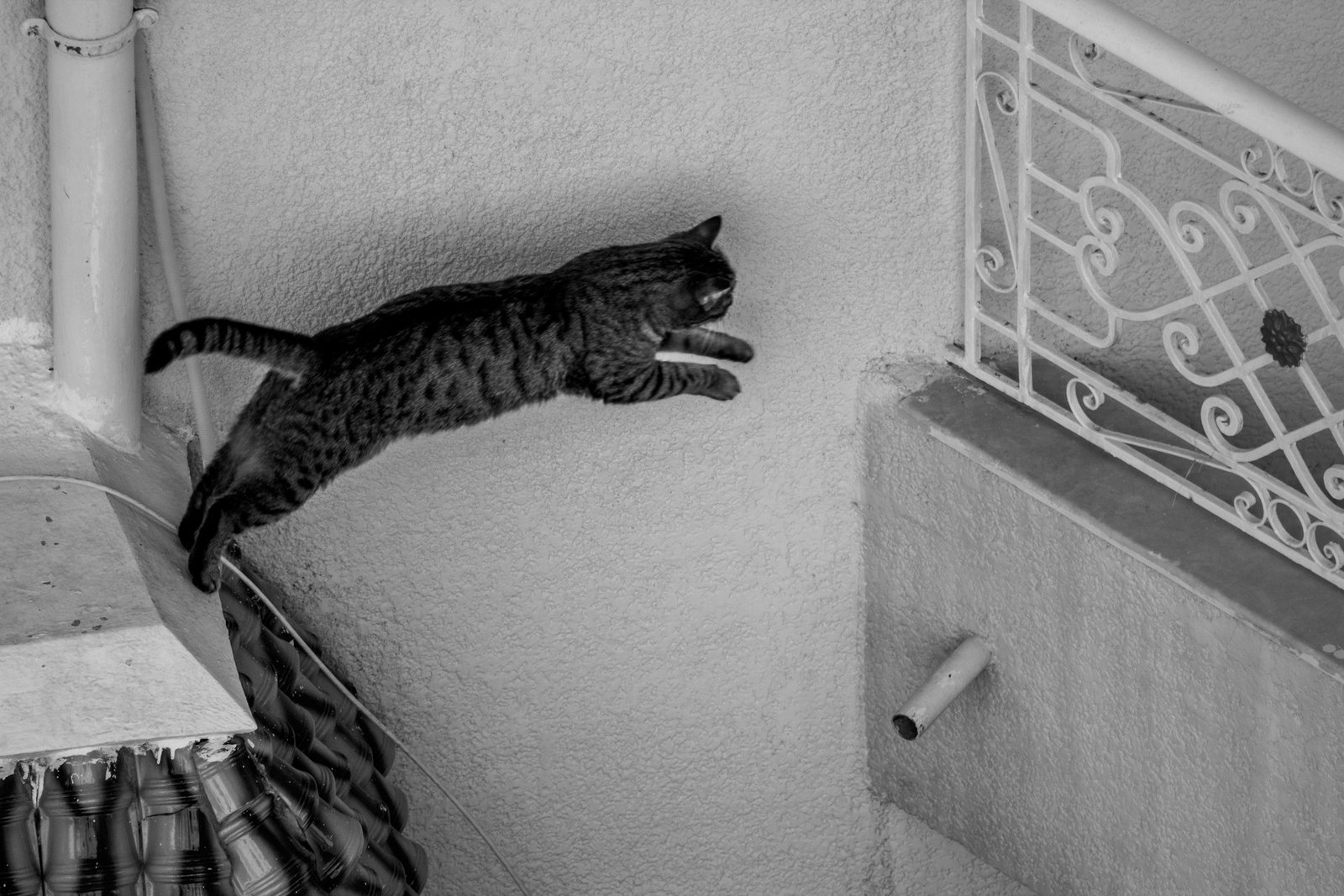

Cats are famous for their agility and their seemingly miraculous ability to survive falls — but a cat falling from a height is always a veterinary emergency, even when your cat appears to walk away unharmed. Internal injuries from falls are not always visible externally, and a cat who seems fine immediately after a fall can deteriorate rapidly within hours.
This guide tells you exactly what to do in the first few minutes, what injuries to expect, and why a vet visit is always necessary after a significant fall.
The Righting Reflex — What It Means and What It Does Not
Cats have a remarkable vestibular system that allows them to right their body during a fall — rotating mid-air to land feet first. This is called the righting reflex, and it is genuinely impressive. However, it has important limitations:
- It requires a minimum distance to work — falls from very low heights (under 1–2 feet) do not give the cat enough time to right
- It reduces impact on the legs and spine but does not eliminate it
- It provides absolutely no protection against internal injuries from the deceleration force of impact
Research has shown that cats falling from greater heights — paradoxically — sometimes sustain less severe injuries than those falling from medium heights (2–6 storeys), because from greater heights they have time to fully right themselves and spread their limbs to create more air resistance. This is sometimes called terminal velocity — at around 5 storeys, a cat reaches a velocity where the body’s natural spread position begins to limit further acceleration.
This research does not mean high falls are safe — it means the relationship between height and injury is not linear. Any fall from a height warrants veterinary assessment.
High-Rise Syndrome — What It Means
Veterinarians use the term “high-rise syndrome” to describe the pattern of injuries seen in cats who fall from buildings — typically windows, balconies, or fire escapes in urban environments. Common injuries include:
- Fractured jaw — the chin often strikes the ground even when the feet land first
- Fractured limbs — particularly front legs, which absorb the impact after the feet
- Pneumothorax — air leaking into the chest cavity, causing lung collapse
- Pulmonary contusions — bruising of the lung tissue
- Ruptured bladder
- Internal bleeding — often from liver, spleen, or kidney damage
- Spinal injuries
- Shock
The critical point: many of these injuries are not immediately visible. A cat may walk away from a fall, appear normal for 30–60 minutes, and then deteriorate rapidly as internal bleeding progresses or a partially collapsed lung worsens.
What to Do Immediately After a Fall
Step 1 — Do Not Rush In
Approach slowly and calmly. An injured, frightened cat will bite and scratch even their most trusted owner. Speak softly as you approach.
Step 2 — Observe Before Touching
From a short distance, assess:
- Is your cat conscious and responsive?
- Are they breathing normally?
- Can they stand and move?
- Is there visible bleeding?
- Is the body in a normal position or are limbs at abnormal angles?
This 30-second observation tells you how serious the situation is before you touch them.
Step 3 — Check Gums
Gently lift the lip and check gum colour. Healthy gums are pink and moist.
- Pale or white gums — internal bleeding, shock — emergency
- Blue or grey gums — respiratory compromise — emergency
- Bright red gums — shock in early stages — emergency
- Normal pink — better sign, but still needs vet assessment
Step 4 — Confine and Warm
Place your cat gently into a carrier lined with a soft towel. Keep them warm — shock causes body temperature to drop. See our hypothermia in cats guide for warming guidance.
For a cat that cannot walk or has a suspected spinal injury — slide carefully onto a flat, rigid surface (clipboard, piece of cardboard) keeping the spine straight. Do not pick up and cradle in the normal way.
Step 5 — Go to the Vet Immediately
Do not wait to see if your cat improves. Do not give food, water, or any medication. Call the vet on the way so they are prepared when you arrive.
Never Do These After a Fall
- Do not give human pain medication — paracetamol, ibuprofen, and aspirin are all toxic to cats and can mask symptoms your vet needs to assess
- Do not assume they are fine because they are walking — internal injuries are not visible
- Do not leave them alone to rest and see what happens — deterioration can be rapid
- Do not squeeze or probe injuries — particularly the abdomen
- Do not delay getting to a vet — the difference between early and delayed treatment for internal bleeding or pneumothorax is genuinely life or death
What to Expect at the Vet
Your vet will immediately assess for shock and life-threatening injuries. Treatment in the first hour focuses on stabilisation:
Immediate assessment:
- Vital signs — heart rate, respiratory rate, blood pressure, temperature
- Gum colour and capillary refill time
- Pain assessment
- Abdominal palpation
Diagnostic tests:
- Chest and abdominal X-rays — checks for pneumothorax, rib fractures, and organ displacement
- Abdominal ultrasound — detects internal bleeding and organ damage
- Blood tests — checks for anaemia (internal bleeding) and organ function
Treatment depending on findings:
- IV fluids for shock
- Oxygen therapy for respiratory compromise
- Chest drain for pneumothorax
- Surgery for internal bleeding, ruptured bladder, or fractured jaw
- Pain management with cat-safe medications
- Fracture stabilisation — see our my cat leg is broken guide for what fracture treatment involves
The 24-Hour Rule — Why Monitoring Continues
Even cats who are stabilised after a fall need monitoring for at least 24 hours. Some complications — particularly pulmonary contusions — worsen in the 12–24 hours after the injury as inflammation develops. A cat who seemed relatively stable at 2 hours post-fall can have significantly more laboured breathing at 12 hours.
Your vet may recommend hospitalisation overnight or advise very specific monitoring at home. Follow these instructions precisely — this is not overcaution.
Falls From Low Heights
Not all falls are from windows or balconies. Cats also fall from:
- Furniture and cat trees
- Stairs — particularly elderly or arthritic cats
- Slipping on smooth flooring
- Misjudging jumps
Falls from low heights (under 3–4 feet) in young, healthy cats rarely cause serious injury. However:
- Any fall resulting in limping, not bearing weight, or obvious pain needs a vet visit
- Senior cats and cats with arthritis are more vulnerable to injury from minor falls
- Any fall where the cat hit their head or landed awkwardly warrants assessment
For elderly cats with mobility problems, see our how to care for a senior dog guide — the mobility and fall-prevention principles apply equally to senior cats.
Preventing Falls
Window safety:
- Fit secure mesh screens to all windows — this is the single most effective prevention measure for urban cats
- Do not assume a cat will not jump from a height they can see — they will
Balcony safety:
- Net balconies with cat-safe netting — this is simple, inexpensive, and highly effective
- Do not leave cats unsupervised on open balconies
Indoor safety:
- For elderly or arthritic cats, provide ramps or steps to favourite elevated spots rather than requiring jumps
- Provide non-slip surfaces on smooth floors and furniture
My Cat Fell From a Height — FAQ
My cat fell from a window and seems completely fine — do I still need to go to the vet? Yes — always, after any significant fall. Internal injuries from falls are not immediately apparent. A cat who seems fine at 30 minutes can deteriorate rapidly at 2–4 hours as internal bleeding progresses. Same-day veterinary assessment is always warranted after a fall from height.
How high does a fall have to be to be dangerous? Any fall that results in an impact can cause injury. Falls from over 2 storeys carry high risk of the injury pattern described in high-rise syndrome. Even falls from lower heights can cause fractures, organ damage, or spinal injury. Height alone does not reliably predict injury severity.
My cat fell and is hiding — should I leave them alone? No — hiding is a sign of pain and distress in cats. A cat who has fallen and is hiding needs to be gently retrieved and assessed. Leaving them alone to recover is not appropriate after a fall from height. See our my cat is sick guide for signs of serious illness to watch for.
Can a cat survive a fall from a very high building? Yes — there are documented cases of cats surviving falls from very high buildings with treatment. The righting reflex and terminal velocity phenomenon mean that survival from high falls is more common than might be expected. However, survival requires prompt, skilled veterinary care — not assuming the cat will be fine.
My cat fell and is limping but otherwise seems okay — how urgent is this? See a vet the same day. Limping after a fall indicates injury — whether a fracture, soft tissue injury, or nerve damage. Do not leave this until the next day.
Also read: My Cat Is Injured — First Aid Guide | My Cat Leg Is Broken — Signs and Treatment | Hypothermia in Cats | My Cat Is Sick — Signs and When to See a Vet