

If you have been searching for a dog that is gentle, intelligent, low-shedding, and absolutely beautiful — the Bernedoodle has probably already caught your eye. And for good reason.
A cross between the Bernese Mountain Dog and the Poodle, the Bernedoodle combines the calm, affectionate nature of the Bernese with the intelligence and low-shedding coat of the Poodle. The result is one of the most popular designer dog breeds in the USA and Canada — and one of the best family dogs available.
This complete guide covers everything — sizes, temperament, grooming, health, training, cost, and what life with a Bernedoodle actually looks like day to day.
What Is a Bernedoodle?
A Bernedoodle is a hybrid dog breed created by crossing a Bernese Mountain Dog with a Poodle. The breed was developed intentionally in 2003 by Sherry Rupke of Swissridge Kennels in Canada, with the goal of combining the best traits of both parent breeds — the Bernese’s loyalty and gentle temperament with the Poodle’s intelligence and hypoallergenic coat.
Bernedoodles are not recognised by the American Kennel Club (AKC) as a purebred breed, but they are recognised by the Designer Dogs Kennel Club and American Canine Hybrid Club. They have become one of the most searched dog breeds in North America due to their combination of looks, temperament, and allergy-friendly coats.
Bernedoodle Sizes — Mini, Standard, and Micro
One of the most appealing things about the Bernedoodle is the range of sizes available. By pairing the Bernese Mountain Dog with different sizes of Poodle, breeders can produce Bernedoodles that fit almost any living situation.
| Size | Weight | Height | Poodle Parent |
|---|---|---|---|
| Micro / Teacup Bernedoodle | 10–24 lbs | Under 12 inches | Toy Poodle |
| Mini Bernedoodle | 25–49 lbs | 18–22 inches | Miniature Poodle |
| Medium Bernedoodle | 50–70 lbs | 19–22 inches | Moyen Poodle |
| Standard Bernedoodle | 70–90 lbs | 23–29 inches | Standard Poodle |
Mini Bernedoodle
The mini Bernedoodle is the most popular size in the USA and Canada. Weighing 25–49 lbs, they are small enough for apartment living if well-exercised, but sturdy enough for active families. Mini Bernedoodles tend to inherit slightly more energy and playfulness from the Miniature Poodle parent.
Standard Bernedoodle
The standard Bernedoodle is the original size — a large, impressive dog that most closely resembles the Bernese Mountain Dog in build. They suit homes with outdoor space and families who want a substantial, gentle giant of a companion.
Micro / Teacup Bernedoodle
The smallest Bernedoodles are produced using a Toy Poodle. They are extremely cute and portable but can be prone to the health sensitivities common in very small dogs. Research breeders carefully if considering a teacup or micro Bernedoodle.
Bernedoodle Generations Explained — F1, F1b, F2
If you have been searching for a Bernedoodle, you have definitely seen these generation codes. Here is what they mean:
| Generation | Parentage | Coat Type | Shedding | Best For |
|---|---|---|---|---|
| F1 | 50% Bernese + 50% Poodle | Wavy or curly | Low–Moderate | First-time Bernedoodle owners |
| F1b | F1 Bernedoodle + Poodle | Curlier | Very low | Allergy sufferers |
| F1bb | F1b Bernedoodle + Poodle | Very curly | Minimal | Severe allergy sufferers |
| F2 | F1 + F1 Bernedoodle | Variable | Low–Moderate | Less predictable coat |
| F2b | F2 Bernedoodle + Poodle | Curlier | Low | Good allergy option |
| Multigen | Multiple generations | Variable curly | Very low | Consistent traits |
For allergy sufferers: An F1b or F1bb Bernedoodle gives you the highest chance of a low-shedding, low-dander coat. The more Poodle in the genetic mix, the curlier and lower-shedding the coat.
For first-time owners: An F1 Bernedoodle with a wavy coat is easier to groom than a fully curly F1b coat and still sheds very little compared to most breeds.
Bernedoodle Temperament — What Are They Really Like?
Temperament is where the Bernedoodle truly shines. This breed combines the best personality traits of two exceptional parent breeds.
Gentle and Affectionate
Bernedoodles are deeply devoted to their families. They form strong bonds with their people and are known for being intuitive — sensing when their owner is stressed or sad and responding with calm, affectionate presence. This is why Bernedoodles make exceptional therapy dogs.
Intelligent and Trainable
The Poodle is the second most intelligent dog breed in the world. Bernedoodles inherit significant intelligence from the Poodle side, making them highly trainable and quick to learn new commands. They respond best to positive reinforcement training — reward-based methods work far more effectively than correction-based approaches.
For step-by-step training guidance, read our guide on how to teach a dog to sit.
Playful and Energetic — But Not Hyper
Bernedoodles are playful and enjoy activity, but they are not a high-energy breed that demands constant stimulation. A standard Bernedoodle is happy with 30–60 minutes of exercise per day. Mini Bernedoodles tend to be slightly more energetic than standards.
Stubborn Streak
The Bernese Mountain Dog side can introduce a stubborn streak — particularly in puppies. Bernedoodles sometimes decide they have better ideas than their owners about what to do next. Consistent, patient training from an early age manages this well. Puppies that receive early obedience training become extremely well-behaved adults.
Good With Children
Bernedoodles are excellent with children of all ages. Their gentle, patient nature makes them tolerant of the unpredictable energy of young children, and their size (particularly standard Bernedoodles) means they are sturdy enough to handle enthusiastic play without being easily injured.
Good With Other Dogs and Pets
Most Bernedoodles get along well with other dogs and household pets. Early socialisation significantly improves inter-animal relationships — expose your Bernedoodle puppy to other dogs, cats, and new people as early and as frequently as possible.
Potential for Separation Anxiety
Bernedoodles are social dogs that bond deeply with their families. Left alone for long periods regularly, they can develop separation anxiety. If you work full-time outside the home, a Bernedoodle needs adequate enrichment, doggy daycare, or a dog walker to stay happy and calm during the day.
For more on managing dogs left alone, read our guide on how long can a dog be left alone.
Bernedoodle Coat Types and Colours
Coat Types
Curly coat — most common in F1b and higher Poodle-percentage Bernedoodles. Low shedding, hypoallergenic-friendly, requires professional grooming every 6–8 weeks. Prone to matting if not brushed regularly.
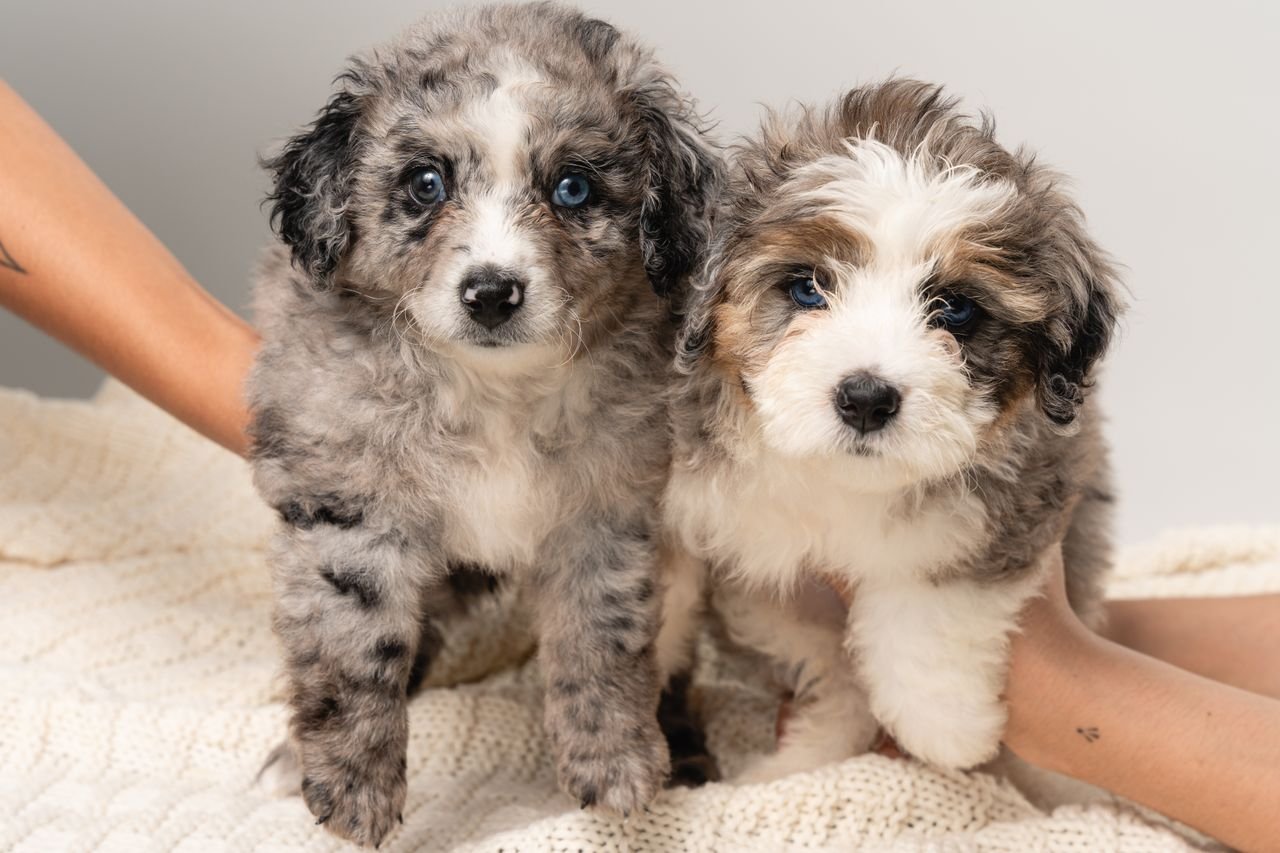
Wavy coat — most common in F1 Bernedoodles. The most popular coat type — lower maintenance than curly, still low-shedding, and has the classic teddy bear appearance most people picture when they think of a Bernedoodle.
Straight coat — occurs in some F1 and F2 Bernedoodles that inherit more Bernese traits. Sheds more than wavy or curly coats and is less suitable for allergy sufferers.
Unfurnished Bernedoodle — an unfurnished Bernedoodle lacks the beard and eyebrow furnishings that give doodles their teddy bear appearance. They have a flatter, shorter face coat. This is a genetic trait, not a grooming difference.
Coat Colours
Bernedoodles come in a stunning range of colours and patterns:
- Tricolor (black, white, and brown) — the classic Bernese Mountain Dog colouring, the most sought-after pattern
- Phantom — two-tone colouring with specific markings above the eyes, muzzle, chest, and legs
- Merle — marbled coat pattern inherited from a merle gene, creating blue, grey, and chocolate marbled effects
- Sable — warm brown tones that often fade as the puppy matures
- Solid black, white, brown — less common than tri or phantom but equally beautiful
- Bi-colour — two-colour combinations including black and white, brown and white
Tricolor Bernedoodles are generally the most expensive due to high demand for the classic Bernese colouring in a low-shedding package.
Bernedoodle Grooming — What You Need to Know
Grooming is one of the most important commitments when owning a Bernedoodle. Their coat requires consistent maintenance to stay healthy, tangle-free, and comfortable.
Brushing
Bernedoodles need brushing 3–5 times per week at minimum — daily brushing is ideal for curly coats. The most common grooming mistake new Bernedoodle owners make is not brushing frequently enough, which leads to matting that can only be resolved by shaving the coat short.
Use a slicker brush for everyday brushing and a metal comb to check for tangles close to the skin — particularly behind the ears, under the armpits, and around the collar.
Slicker brush and metal comb set for doodle grooming
Professional Grooming
Bernedoodles need professional grooming every 6–8 weeks. A full groom includes a bath, blow-dry, brush-out, trim, nail clip, and ear cleaning. Costs typically run $80–$150 per session depending on size and coat condition.
For professional Bernedoodle grooming, Paw Care Buddy connects dog owners with experienced groomers who specialise in doodle coats — ensuring your Bernedoodle gets the specialist care their coat requires.
Bathing
Bernedoodles should be bathed every 4–6 weeks or as needed. Always brush thoroughly before bathing — washing a matted coat tightens the mats and makes them harder to remove. Use a dog-specific shampoo and conditioner appropriate for their coat type.
Hypoallergenic dog shampoo and conditioner for doodle coats
Ear Cleaning
Bernedoodles — particularly those with curly coats — are prone to ear infections because their floppy ears trap moisture and reduce airflow. Check and clean ears every 2–3 weeks. Signs of infection include head shaking, ear scratching, dark discharge, or unpleasant smell from the ear canal.
For a detailed guide on ear cleaning, read our article on how to clean cat ears at home — the same gentle principles apply to dogs.
Nail Trimming
Nails should be trimmed every 3–4 weeks. Long nails cause discomfort when walking and can affect gait over time. For step-by-step guidance, read our guide on how to trim cat nails without getting scratched — the principles of nail trimming are essentially the same for dogs.
Bernedoodle Exercise Requirements
Exercise needs vary by size and generation.
| Size | Daily Exercise | Best Activities |
|---|---|---|
| Micro / Teacup | 20–30 minutes | Short walks, indoor play |
| Mini Bernedoodle | 30–45 minutes | Walks, fetch, off-leash play |
| Medium Bernedoodle | 45–60 minutes | Hiking, fetch, swimming |
| Standard Bernedoodle | 60 minutes | Hiking, swimming, agility |
Bernedoodles enjoy variety in their exercise — the same walk every day can become mentally unstimulating. Mix up routes, include off-leash time in safe areas, and incorporate enrichment activities like sniff games and puzzle feeders alongside physical exercise.
Standard Bernedoodles should not be over-exercised as puppies — their growth plates are still developing until around 18 months and high-impact exercise before this can cause joint damage. Stick to age-appropriate activity levels as recommended by your vet or breeder.
Bernedoodle Health — Common Issues to Know
Bernedoodles are generally healthier than their purebred parent breeds thanks to hybrid vigour — the tendency of mixed-breed dogs to have fewer inherited health problems than purebreds. However, they can still inherit health conditions from either parent line.
Hip and Elbow Dysplasia
Common in both Bernese Mountain Dogs and large Poodles. Reputable breeders health-test breeding parents and can show you OFA (Orthopedic Foundation for Animals) certification for hip and elbow scores.
Skin Conditions
Some Bernedoodles are prone to skin irritation, hot spots, and allergies — particularly those with very curly coats that trap moisture close to the skin.
Eye Conditions
Progressive Retinal Atrophy (PRA) can be inherited from either parent line. DNA testing of breeding parents can identify carriers.
Von Willebrand Disease
A blood clotting disorder that can be inherited from the Bernese Mountain Dog line. Again, reputable breeders test for this.
Cancer
Bernese Mountain Dogs have one of the highest cancer rates of any breed — around 50% of Bernese die from cancer. Bernedoodles benefit from hybrid vigour but the Bernese side still increases cancer risk compared to many other breeds. This makes pet insurance particularly important for Bernedoodle owners.
For a full guide on recognising early warning signs of illness in your Bernedoodle, read our guide on how to tell if your cat is sick — many of the same distress signals apply to dogs.
Bernedoodle Lifespan
| Size | Average Lifespan |
|---|---|
| Micro / Teacup | 14–18 years |
| Mini Bernedoodle | 13–17 years |
| Medium Bernedoodle | 12–15 years |
| Standard Bernedoodle | 12–15 years |
Smaller Bernedoodles tend to live significantly longer than standard Bernedoodles — one of the reasons mini Bernedoodles are particularly popular with families who want a long-lived companion.
Are Bernedoodles Hypoallergenic?
Bernedoodles are often described as hypoallergenic — but like all dogs, no Bernedoodle is completely allergen-free. All dogs produce the Fel d1-equivalent protein Can f1 in their saliva and skin, which is what triggers allergic reactions.
What makes Bernedoodles a better choice for allergy sufferers is their low-shedding coat — less fur in the environment means less dander and less allergen exposure. F1b and higher-generation Bernedoodles with curly Poodle-dominant coats are the most suitable for people with dog allergies.
If allergies are a significant concern, spend time with the specific dog before committing to adoption, and consider an F1b or multigen Bernedoodle from a reputable breeder who can confirm low-shedding coat genetics.
Bernedoodle Cost — What to Expect in 2026
Bernedoodle prices vary significantly by size, generation, coat colour, and breeder reputation.
| Size / Type | Typical Price Range |
|---|---|
| Standard Bernedoodle | $2,000–$4,000 |
| Mini Bernedoodle | $2,500–$5,000 |
| Micro / Teacup Bernedoodle | $3,000–$6,000 |
| Tricolor or Merle (premium) | $4,000–$8,000+ |
| Trained Bernedoodle | $8,000–$20,000+ |
Prices are higher for tricolor, phantom, and merle coats due to high demand. F1b and higher-generation Bernedoodles are often priced higher than F1 dogs. Reputable breeders who health-test parents appropriately are not the cheapest — and that is a good thing.
Adoption is also possible — Bernedoodle rescues and doodle-specific rescue organisations across the USA and Canada occasionally have Bernedoodles available. Search platforms like Petfinder for available dogs near you.
Finding a Reputable Bernedoodle Breeder
With the Bernedoodle’s popularity comes a significant number of backyard breeders and puppy mills producing puppies without health testing or ethical breeding practices. Knowing what to look for protects you and the dog.
Signs of a reputable Bernedoodle breeder:
- Health tests both parents for hips, elbows, eyes, heart, and Von Willebrand disease
- Can show you OFA certifications and DNA test results
- Welcomes you to visit and meet the parent dogs
- Does not have multiple litters always available — reputable breeders have waitlists
- Provides a health guarantee and take-back policy
- Socialises puppies from birth with people, sounds, and environments
- Asks you questions to ensure their puppy is going to the right home
Red flags to avoid:
- No health testing of parents
- Multiple breeds always available
- Puppies ready to go before 8 weeks
- No visit allowed to the breeding facility
- Pressure to buy quickly or pay a deposit before seeing the puppy
Frequently Asked Questions
What is a Bernedoodle? A Bernedoodle is a hybrid dog breed — a cross between a Bernese Mountain Dog and a Poodle. They are known for their low-shedding coats, gentle temperament, and high intelligence. They come in standard, mini, and micro sizes depending on the size of Poodle used in breeding.
Are Bernedoodles good family dogs? Yes — Bernedoodles are excellent family dogs. They are gentle with children, patient and affectionate, highly trainable, and low-shedding. They adapt well to family life and form strong bonds with all members of the household.
How much do Bernedoodles shed? Bernedoodles shed very little — particularly F1b and curly-coated dogs. Wavy-coated F1 Bernedoodles shed slightly more but still far less than most breeds. They are one of the best options for families who want a dog but dislike heavy shedding.
How long do Bernedoodles live? Mini Bernedoodles typically live 13–17 years. Standard Bernedoodles live 12–15 years. Micro Bernedoodles can live up to 18 years. Smaller sizes generally live longer.
Are Bernedoodles easy to train? Yes — Bernedoodles are highly intelligent thanks to their Poodle genetics and respond very well to positive reinforcement training. They can have a stubborn streak from the Bernese side, so consistent, patient training from puppyhood is important.
How much does a Bernedoodle cost? Bernedoodles typically cost $2,000–$5,000 from a reputable breeder. Tricolor, merle, and phantom coats command premium prices of $4,000–$8,000+. Fully trained Bernedoodles can cost $10,000–$20,000+.
Conclusion
The Bernedoodle is one of the most well-rounded dog breeds available today — combining the Bernese Mountain Dog’s gentle, loyal temperament with the Poodle’s intelligence and low-shedding coat. Whether you choose a standard, mini, or micro Bernedoodle, you are getting a dog that is genuinely suited to family life, smart enough to train easily, and beautiful enough to stop traffic on every walk.
The commitment to grooming is real — budget for professional grooming every 6–8 weeks and daily brushing at home. For professional doodle grooming near you, Paw Care Buddy is an excellent resource for finding specialist groomers who understand doodle coats.
For more dog care advice, read our guides on how to crate train a puppy, best dog training treats, and best pet insurance for dogs in the USA.
Always buy from a reputable breeder who health-tests their dogs, or consider adopting from a Bernedoodle rescue. Never purchase from a pet shop or unverified online listing.
Also read: How to Crate Train a Puppy | Best Dog Training Treats | Best Pet Insurance for Dogs in the USA | How Long Can a Dog Be Left Alone? | How to Care for a Senior Dog