


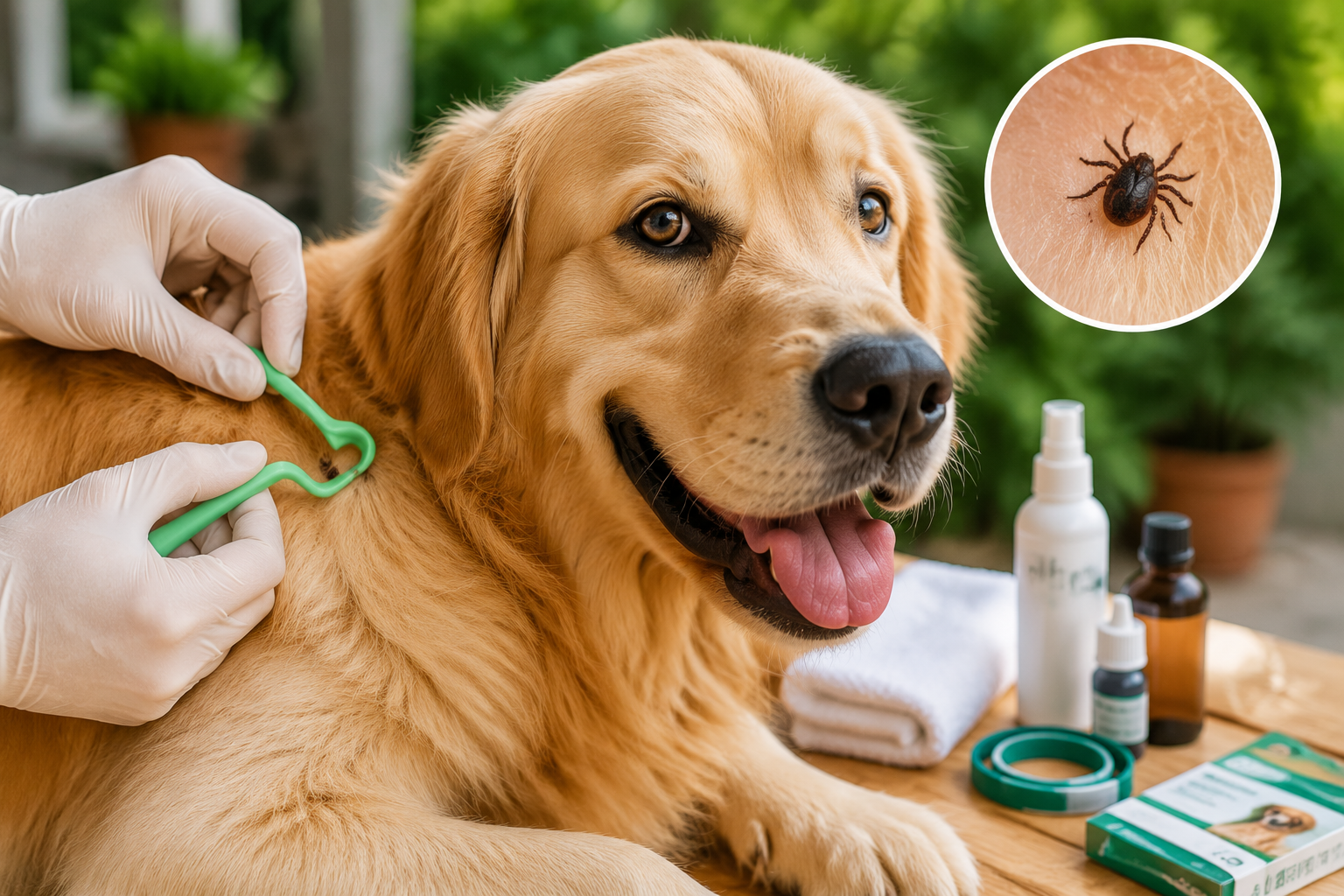

Ticks on dogs are more than just unpleasant — they transmit serious diseases including Lyme disease, Rocky Mountain spotted fever, and ehrlichiosis, all of which can cause lasting health problems if not caught early. Knowing how to find ticks, remove them safely, and prevent them in the first place is essential knowledge for every dog owner.
Where Do Dogs Pick Up Ticks?
Ticks live in grass, woodland, scrubland, and leaf litter — anywhere with wildlife activity. Your dog picks them up by brushing against vegetation where ticks wait to latch onto a passing host. They are most active in spring and autumn but in warmer US states, tick season is effectively year-round.
High-risk environments include:
- Wooded trails and hiking paths
- Long grass and meadows
- Parks where deer or other wildlife are present
- Beaches with dune grass
How to Check Your Dog for Ticks
Check your dog after every walk in high-risk areas. Ticks prefer warm, hidden spots — run your fingers slowly through the coat and press gently against the skin, feeling for small bumps.
Check these areas carefully:
- Between the toes and around the paw pads
- Inside and around the ears
- Around the collar area and neck
- Under the legs and in the armpits (axillae)
- Around the tail base and between the hind legs
- Around the face and lips
A recently attached tick is tiny — sometimes as small as a poppy seed. An engorged tick (attached for several hours or more) is larger and easier to spot, ranging from pea-sized upward depending on species.
How to Remove a Tick Safely
The method matters. Incorrect removal increases the risk of the tick’s mouth parts breaking off under the skin or of the tick regurgitating into the wound — both of which increase disease transmission risk.
What you need: A tick removal tool (a tick hook or tick twister) or fine-tipped tweezers. These are inexpensive and every dog owner should have one.
Step by step:
- Part the fur to expose the tick clearly
- Grasp the tick as close to the skin surface as possible — around the head, not the body
- Pull upward with steady, even pressure — do not twist, jerk, or squeeze the body
- Once removed, place the tick in a sealed bag or jar (in case your vet needs to identify the species)
- Clean the bite site with antiseptic
- Wash your hands thoroughly
Never: Use petroleum jelly, nail polish, heat, or alcohol to try to make the tick detach — these methods cause the tick to regurgitate into the wound, increasing disease risk.
Signs of Tick-Borne Disease in Dogs
After a tick bite, monitor your dog for 30 days. Contact your vet if you notice:
- Fever and lethargy
- Loss of appetite
- Lameness or joint swelling — a hallmark sign of Lyme disease
- Swollen lymph nodes
- Reluctance to move
- Bruising or unexplained bleeding
Early treatment of tick-borne diseases with antibiotics is very effective. Delayed treatment can lead to serious long-term complications. According to the American Kennel Club, Lyme disease is one of the most common tick-transmitted diseases in the USA, affecting thousands of dogs annually.
Tick Prevention Products — What Works
Prevention is far preferable to removal. A dog on effective tick prevention is significantly less likely to have ticks attach and feed — and feeding time is what allows disease transmission to occur.
Spot-On Treatments
Applied monthly to the back of the neck. Highly effective, convenient, and widely used. Products containing fipronil, permethrin, or fluralaner kill ticks on contact before or shortly after attachment.
Oral Tick Preventatives
Chewable tablets given monthly or every 3 months. Products containing afoxolaner (NexGard), fluralaner (Bravecto), or sarolaner (Simparica) kill ticks after they attach but before disease transmission occurs. Prescription required from your vet.
Tick Collars
The Seresto collar provides 8 months of continuous tick and flea protection and is one of the most cost-effective long-term options for dogs in high-exposure areas.
Tick Repellent Sprays
Useful as an additional layer of protection during high-risk activities like hiking. Not a substitute for a primary prevention product.
Tick Prevention Comparison
| Product Type | Duration | Prescription Needed | Best For |
|---|---|---|---|
| Spot-on treatment | Monthly | No | General prevention |
| Oral chewable | Monthly or 3-monthly | Yes | High-exposure dogs |
| Tick collar | 8 months | No | Long-term convenience |
| Spray | Hours | No | Additional protection |
Tick Treatment for Dogs — FAQ
Can I use a human tick remover on my dog? Yes — fine-tipped tweezers or a tick removal hook works on dogs as effectively as on humans. The technique is the same.
How long does a tick need to be attached to transmit disease? For Lyme disease, ticks generally need to be attached for 36–48 hours to transmit the bacteria. For other diseases like Rocky Mountain spotted fever, transmission can occur faster. This is why daily checks and prompt removal matter.
My dog had a tick — do they need to see the vet? Not immediately if the tick was removed completely and your dog seems well. Monitor for 30 days for signs of tick-borne illness listed above. If your dog lives in a high Lyme disease area, your vet may recommend a Lyme disease test and the Lyme vaccine.
Are ticks dangerous to humans too? Yes — ticks removed from your dog can attach to you. Always use gloves or a tick tool when removing ticks, wash hands thoroughly afterward, and check yourself after handling a tick-infested dog.
Can indoor dogs get ticks? Less commonly, but yes — ticks can be carried inside on clothing, shoes, or other pets. Year-round prevention is recommended regardless of how much outdoor time your dog has.
Menu placement: DOG → Dog Health
Also read: My Dog Is Not Eating | How to Care for a Senior Dog | Best Dog Food for Allergies | Dog Anxiety — Signs, Causes and Treatments