

You are standing in the pet store aisle staring at forty different bags of training treats. They all claim to be the best. They all claim to be healthy. Half of them are the size of a golf ball, which is clearly wrong, and the other half have ingredient lists longer than a pharmacy receipt. You grab one, get home, and your dog sniffs it and walks away.
The best dog training treats are not the ones with the most marketing behind them. They are the ones that make your dog’s eyes light up — treats so motivating that your dog will focus on you even in a park full of distractions, other dogs, and interesting smells. This guide tells you exactly what makes a training treat effective, the five categories that work best, what high-value actually means and how to use it, the best options for puppies, sensitive stomachs, and picky dogs, and the one training tool that makes every treat more effective.
What Makes a Training Treat Actually Work?
Before looking at specific products, understanding what makes a treat effective changes how you shop and how you train.
Size — small is always correct. Training treats should be no larger than your thumbnail — ideally pea-sized or smaller. Large treats take too long to eat, interrupt the training rhythm, fill your dog up quickly, and add excessive calories to every session. A single training session might involve 30 to 50 treat repetitions — at pea size, this is manageable. At thumbnail size, you have overfed your dog in ten minutes.
Softness — soft beats crunchy every time. Soft treats are eaten immediately — one second, the treat is gone, training continues. Crunchy biscuits take 10 to 30 seconds to eat, during which your dog’s attention is on the biscuit, not on you. For rapid-fire training — sit, down, stay, recall — soft treats are significantly more effective.
Smell — the stronger the better. Dogs experience the world primarily through smell. A treat that smells intensely is far more motivating than one that smells of almost nothing. Freeze-dried meats, cheese, fish-based treats, and cooked chicken all have strong smells that cut through environmental distractions. Many commercial treats — particularly “light” or low-calorie biscuits — have almost no smell and produce almost no motivation in dogs working in stimulating environments.
Value — match the treat to the challenge. Not every training moment requires your highest-value treat, and not every treat motivates every dog equally. Understanding treat hierarchy — which treats your dog finds most motivating — allows you to save the best for the hardest challenges and use lower-value treats for easy, familiar tasks.
Single ingredient or short list — best for sensitive dogs. Many dogs have food sensitivities that react to complex treat ingredients. For dogs with sensitive stomachs — as we covered in our guide to the best food for dogs with sensitive stomachs — single-ingredient treats like freeze-dried chicken, beef liver, or salmon eliminate the guesswork and the risk of digestive reactions during training.
The 5 Best Types of Dog Training Treats
Type 1 — Freeze-Dried Meat Treats
Freeze-dried treats are consistently the highest-rated training treats among professional dog trainers — and the reason is simple. Freeze-drying removes moisture while preserving virtually all the original meat flavour and smell. The result is a treat that smells intensely of real meat, is lightweight and easy to carry, breaks apart easily into smaller pieces, and has no artificial additives.
Best options: Freeze-dried chicken breast, freeze-dried beef liver, freeze-dried salmon, freeze-dried turkey.
Beef liver is particularly notable — it is intensely aromatic, deeply motivating for the vast majority of dogs, and available in freeze-dried form from multiple brands. Many professional trainers use freeze-dried liver as their go-to high-value treat for the most challenging training scenarios — recall, focus around other dogs, and new environment work.
What to look for: Single ingredient — the label should say “beef liver” or “chicken breast” and nothing else. No preservatives, no additives, no fillers.
Recommend freeze-dried beef liver treats.
Type 2 — Soft Commercial Training Treats
Soft, small commercial training treats are the most practical day-to-day option for most owners. They are pre-sized, easy to carry, and consistently soft enough for immediate eating. The best versions use real meat as the primary ingredient, are appropriately small, and have a short, recognisable ingredient list.
What to look for:
- Named meat as the first ingredient — chicken, turkey, beef, salmon
- Soft texture — the treat should compress between your fingers
- Small size — 1cm or smaller ideally
- Low calorie content — training involves many repetitions; caloric density matters for regular trainers
What to avoid in commercial treats:
- Corn or wheat as the first ingredient
- Artificial colours, flavours, or preservatives
- Treats that crumble or require chewing — these disrupt training rhythm
- Treats that smell of almost nothing when you open the bag
Recommend a specific soft training treat.
Type 3 — Real Food — The Most Motivating Options
Real human food — properly selected — consistently outperforms commercial treats for most dogs. The smell is stronger, the texture is immediately appealing, and many dogs simply prefer real food to processed alternatives.
The best real food training treats:
Cooked chicken breast (plain, no seasoning): The gold standard for most dogs. Cut into pea-sized pieces, carried in a treat pouch or zip-lock bag. Motivates even picky dogs. No salt, no garlic, no onion — plain boiled or baked only.
Cheese: Small cubes of regular cheddar, string cheese, or cream cheese on a spoon. Highly motivating for almost all dogs. Use sparingly as cheese is high in fat — best reserved for high-value moments.
Hot dogs (plain, low-sodium): Controversial in some circles but extremely effective as a high-value treat. Cut into tiny pieces. Use occasionally for the most challenging training tasks rather than as a routine treat.
Plain cooked beef or turkey: Similar to chicken — plain, unseasoned, pea-sized pieces.
Peanut butter (xylitol-free): On a lick mat or spoon for stationary training exercises like stay or place. Always check the label — xylitol is toxic to dogs and appears in some reduced-sugar peanut butter brands.
What to absolutely avoid in real food: Grapes, raisins, onions, garlic, macadamia nuts, chocolate, anything containing xylitol. These are toxic to dogs.
Type 4 — Soft Training Treats for Puppies
Puppies have smaller mouths, developing digestive systems, and even shorter attention spans than adult dogs — which makes treat selection for puppy training particularly important.
What puppies need from training treats:
- Very small size — even smaller than adult training treats
- Very soft texture — puppies should be able to eat the treat in under 2 seconds
- Simple, gentle ingredients — puppy digestive systems are more sensitive than adults
- Age-appropriate caloric content — puppies have specific nutritional needs, and excessive treats can unbalance a diet
The best puppy training treats use single or limited protein sources, are appropriately tiny, and are made without artificial additives. Many adult training treats can be broken into smaller pieces for puppies — this is both cost-effective and appropriate.
As we covered in our guide to how to crate train a puppy, treats are central to effective puppy training — the right treat in the right moment creates the positive associations that form lasting behaviour. Recommend a puppy-specific training treat.
Type 5 — Training Treats for Dogs With Sensitive Stomachs
For dogs with food sensitivities, allergies, or digestive issues, treat selection becomes a health consideration as well as a training one.
Best approach for sensitive dogs:
- Single-ingredient treats only — freeze-dried single protein is ideal
- Novel protein — if your dog is sensitive to chicken or beef, use a protein they have not been previously exposed to: rabbit, venison, duck, or fish
- Limited ingredient commercial options — specifically formulated sensitive stomach treats exist, but always read the ingredient list rather than relying on the label alone
- Real food from their existing diet — if your dog eats a salmon-based food, plain cooked salmon pieces are a safe, well-tolerated training treat
Avoid treats with multiple protein sources, artificial additives, wheat, corn, or dairy if your dog has known sensitivities.
Understanding High-Value vs Low-Value Treats
This is one of the most important concepts in training — and the one most owners do not use strategically.
High-value treats are the ones your dog finds most motivating. They are reserved for:
- New and difficult behaviours being learned for the first time
- High-distraction environments — parks, streets, around other dogs
- Recall training — coming back when called is the most important safety command and deserves the best reward you have
- Any situation where your dog is finding it difficult to focus on you
Low-value treats are used for:
- Easy, well-established behaviours in low-distraction environments
- Maintaining behaviours your dog already knows reliably
- Routine asks — sit before meals, sit before the leash goes on
The practical hierarchy for most dogs:
- Freeze-dried liver or real chicken — highest value
- Cheese or hot dog pieces — very high value
- Soft commercial training treats — standard training value
- Dry biscuits — lowest value, routine maintenance only
Knowing your dog’s hierarchy means you can save the best for when it matters most — and not burn through your high-value treats on behaviours your dog already knows perfectly well.
The Best Dog Treat Pouch — Why It Matters
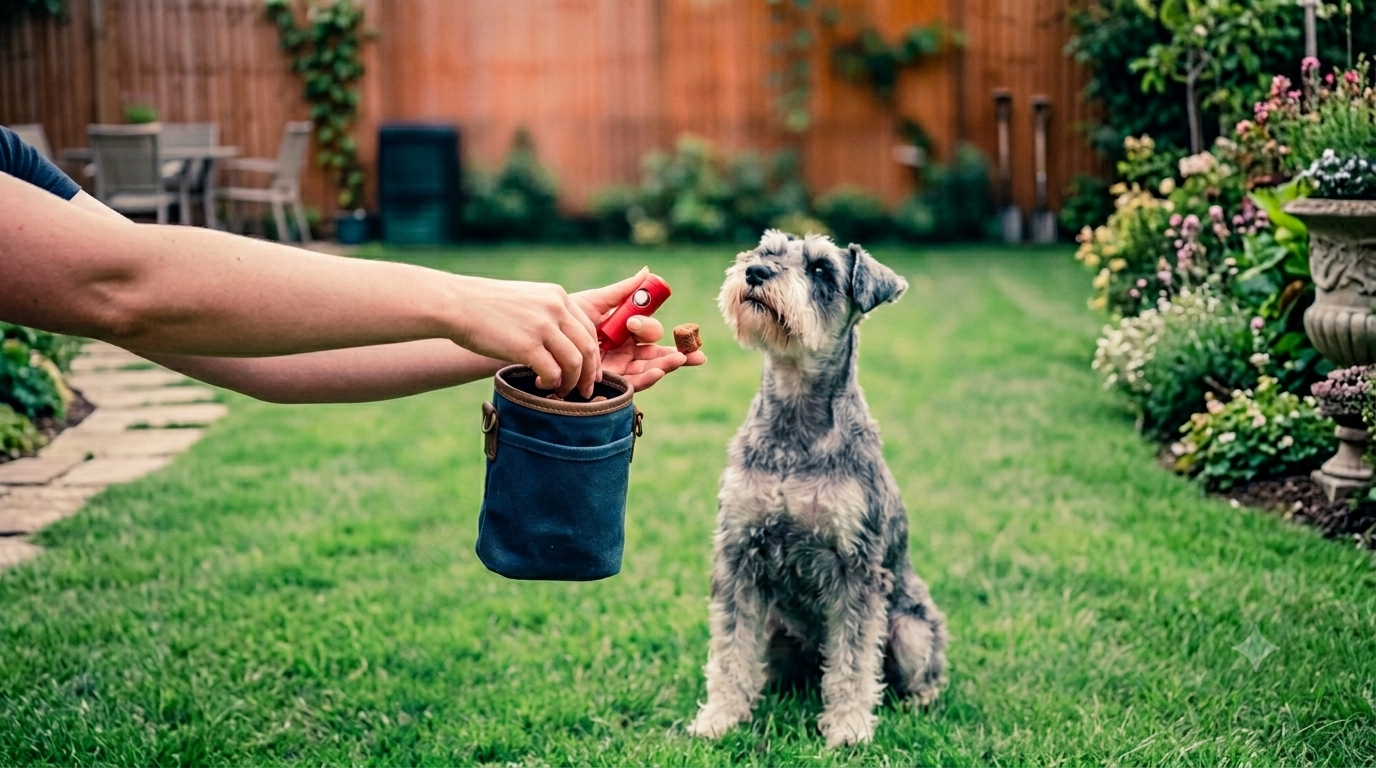
A treat pouch is not a luxury — for anyone doing regular training, it is an essential tool. A treat pouch clips to your waist or belt, keeps treats accessible with one hand, and means you never have to fumble with a bag or pocket during a training session.
What to look for in a treat pouch:
- Magnetic or spring-loaded closure — opens with one hand without looking
- Appropriate size — large enough for a training session’s worth of treats, small enough to be unobtrusive
- Easy to clean — training treats leave residue; the pouch needs regular washing
- Secure attachment — a pouch that falls off mid-walk is worse than no pouch at all
- Multiple compartments — useful for carrying two treat values at once for graduated reward training
Recommend a dog treat training pouch.
As we covered in our guide to how to stop a dog from pulling on the leash, having treats immediately accessible without fumbling or looking away from your dog is what allows fast, precise reward timing — and timing is everything in training.
How Many Treats Is Too Many? Keeping Training Healthy
This is a legitimate concern — treats add calories, and a dog receiving 50 treats per training session needs those calories accounted for in their daily intake.
The practical approach:
- Use a portion of your dog’s daily kibble as training treats — particularly for easy, familiar tasks. For dogs motivated by their regular food, this means zero additional calories.
- Reduce the meal portion on heavy training days — if your dog receives significant treats during training, reduce their evening meal accordingly.
- Use the smallest pieces possible — a pea-sized piece of chicken is equally effective as a golf-ball-sized one, and contains a fraction of the calories.
- Factor treats into daily calorie allowance — particularly for dogs on weight management plans or those prone to weight gain.
For small breeds especially, it is easy to accidentally overfeed during training sessions using standard treat sizes. Always cut treats down to the smallest size that is still easily deliverable and quickly eaten.
Best Training Treats by Breed and Size
Small Breeds — Chihuahuas, Yorkies, Shih Tzus, Toy Poodles
Tiny dogs need tiny treats — a piece that would be pea-sized for a Labrador is proportionally much larger for a 3kg Chihuahua. Break all treats into very small pieces — blueberry-sized or smaller. Choose soft treats that can be eaten in under one second. Low-calorie options matter more for small breeds given how quickly calories add up relative to body weight.
Large Breeds — Labradors, German Shepherds, Golden Retrievers, Huskies
Large breeds can handle slightly larger pieces — but “slightly” is the key word. Standard commercial training treats are often appropriately sized for large breeds without further breaking. High-value options matter more for high-drive large breeds that need strong motivation to focus in stimulating environments.
Working and High-Drive Breeds — Border Collies, Belgian Malinois, Australian Shepherds
For high-drive working breeds, treat value is critical. These dogs have the drive to work but also the intelligence to make cost-benefit calculations about whether the reward is worth the effort in a given environment. Always use high-value treats with working breeds, particularly in novel environments. For some working breed dogs, a toy or play reward is actually more motivating than any food — worth testing if food motivation seems low.
Sensitive Stomach Breeds — French Bulldogs, German Shepherds, Boxers
As covered in the sensitive stomach section above — single ingredient, limited protein treats are the correct starting point. Freeze-dried single protein is the safest and most effective option for these breeds.
FAQ — Best Dog Training Treats
Q: What are the best high-value dog training treats? A: For most dogs, freeze-dried beef liver or freeze-dried chicken are the highest-value commercial options. For real food, plain cooked chicken breast and small cheese cubes are consistently the most motivating options. The best high-value treat for your specific dog is whatever makes their eyes light up and overrides distractions — which may require some testing to discover.
Q: What are the healthiest dog training treats? A: Single-ingredient freeze-dried meats — chicken, liver, salmon — are the healthiest training treats. They contain nothing but the named protein, no artificial additives, and are highly digestible. Plain cooked chicken or turkey is equally healthy and often more cost-effective for high-volume trainers.
Q: Can I use kibble as a training treat? A: Yes — and for many dogs, particularly food-motivated breeds, kibble works well for easy tasks in low-distraction environments. The advantages are zero additional calories and no dietary disruption. The limitations are lower motivation in challenging environments and slower eating time compared to soft treats.
Q: How small should training treats be? A: Pea-sized for medium to large dogs. Blueberry-sized or smaller for small breeds and puppies. The treat should be eaten in under two seconds — if your dog is chewing, it is too big.
Q: Are homemade training treats effective? A: Extremely — and often more so than commercial options. Plain cooked chicken, beef, turkey, or fish cut into small pieces are among the most effective training treats available. Freeze-dried liver at home (using a dehydrator or low oven) is another excellent option. The advantage is knowing exactly what is in the treat and adjusting for your dog’s dietary needs.
Q: What treats work best for puppy training? A: Puppy-specific soft treats, tiny pieces of freeze-dried single protein, or very small pieces of plain cooked chicken. The treat must be eaten in under two seconds and must be motivating enough to compete with the intense distraction of being a puppy in a stimulating world. Test several options and observe which one produces the fastest, most reliable response.
Conclusion
The best dog training treats are the ones that motivate your individual dog reliably — in the environments and situations where you need them most. For most dogs, that means freeze-dried single-protein treats or real food for high-value moments, and soft commercial training treats for everyday work.
Size small, texture soft, smell strong. Match treat value to training challenge. Keep a treat pouch so rewards are always immediate. Account for treat calories in your dog’s daily intake. And remember — the treat is not the training. It is the fuel that makes the training possible.
A dog that is well-rewarded learns faster, retains more, and is more enthusiastic about training sessions than one that is under-rewarded or rewarded inconsistently. Invest in the right treats, use them strategically, and your training results will reflect it.
Also read: How to teach a dog to sit | How to stop a dog from pulling on the leash | Why does my dog jump on me? | How to crate train a puppy | Best food for dogs with sensitive stomachs | How to stop a dog from barking at night