
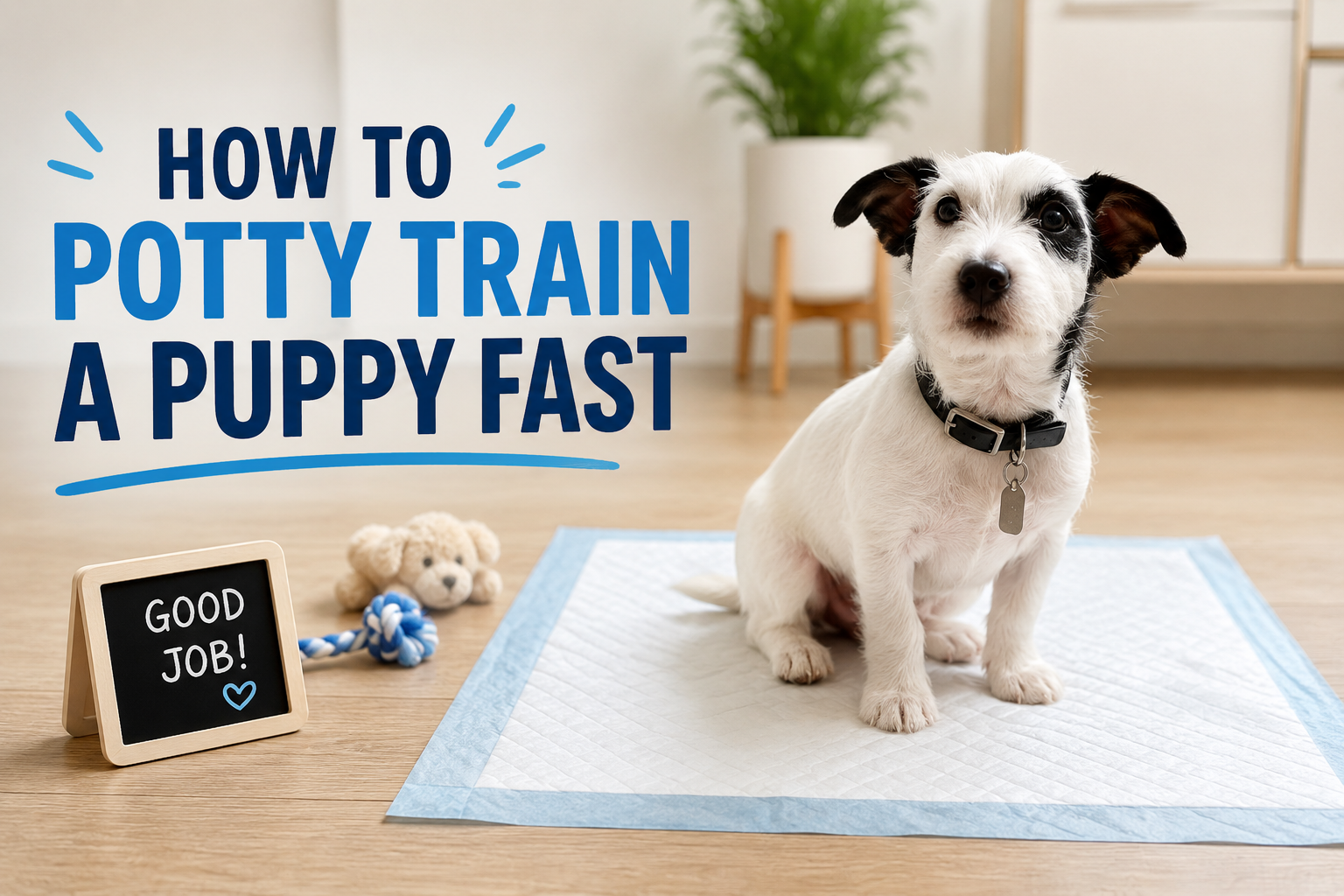

You just brought home a puppy and the accidents are already adding up. The kitchen floor, the rug, behind the sofa — nowhere feels safe anymore. You want results quickly, and you want a method that actually works.
The good news is that how to potty train a puppy is one of the most achievable training goals — when you follow the right steps consistently. Most puppies can be reliably house trained within 4–8 weeks. Some pick it up faster. The difference between fast success and months of frustration almost always comes down to consistency and timing, not the puppy.
This guide gives you the complete, step-by-step potty training system — schedules, crate use, pad training, night training, and how to handle setbacks — so you can get through this stage as quickly as possible.
Why Puppies Are Hard to Potty Train
Before you start, it helps to understand what you are actually working with.
Puppies cannot hold their bladder for long. A general rule of thumb is one hour per month of age — so an 8-week-old puppy can hold their bladder for roughly 2 hours maximum, and often less when excited, just woken up, or after eating. Expecting a young puppy to hold it for longer is physically impossible and sets everyone up to fail.
Puppies do not have full bladder control until around 4–6 months old. Before that, accidents happen even when the puppy is trying their best. This is not stubbornness — it is physiology.
Puppies have no concept of “outside” or “appropriate spot” until you teach it. They are not being bad when they go indoors. They simply go wherever they are when the urge hits. Your job is to be present and consistent enough that you teach them where the right place is before the habit of going indoors gets established.
Understanding this removes frustration and puts you in the right mindset for training.
What You Need Before You Start
Getting these basics in place before training begins makes everything faster:
- A crate the right size — just big enough for the puppy to stand, turn around, and lie down. Too large and they will use one corner as a toilet. A crate divider lets you expand the space as they grow.
- A designated toilet spot — choose one consistent spot in the garden or on your training pads and always take the puppy to the same place. Familiar scent helps trigger the urge to go.
- High-value treats — small, soft, smelly treats that your puppy goes crazy for. These are specifically for rewarding successful toileting outside. The reward must come within 2–3 seconds of the puppy finishing, not when they come back inside.
- An enzymatic cleaner — regular household cleaners do not break down the urine proteins that attract puppies back to the same spot. An enzymatic cleaner does. This is non-negotiable.
- Puppy training pads (if using an indoor option) — especially useful for apartment dwellers, high-rise buildings, or young puppies in cold climates.
The Potty Training Schedule — The Foundation of Fast Results
A consistent schedule is the single most powerful tool in potty training. The less guesswork there is, the faster your puppy learns.
Take your puppy to their toilet spot immediately after each of these:
| When to Go Outside | Why |
|---|---|
| First thing in the morning | Bladder is full after the night |
| After every meal | Eating triggers the digestive reflex within 5–30 minutes |
| After every nap or rest | Bladder fills while sleeping |
| After every play session | Excitement increases urgency |
| After any excitement | Greeting, visitors, play fighting |
| Every 1–2 hours throughout the day | General bladder management |
| Last thing at night | Empty before overnight crating |
For an 8-week-old puppy, this means going outside 8–12 times per day. That sounds like a lot — and it is — but this intensive period lasts only a few weeks before you can start extending the gaps.
Step-by-Step Potty Training Method
Step 1 — Establish the Crate as the Foundation
The crate is your most powerful potty training tool. Dogs instinctively avoid soiling where they sleep, so a correctly sized crate teaches natural bladder control.
Your puppy should be in the crate whenever you cannot directly supervise them. This is not cruel — it is safe and teaches self-control faster than any other method. Make the crate comfortable with bedding and leave the door open when supervised so it becomes a place they choose to rest.
Read our detailed guide on how to crate train a puppy for the full crate training process — it works hand-in-hand with potty training.
Step 2 — Supervise Intensely When Outside the Crate
When your puppy is not in the crate, they need eyes on them at all times. Tether them to you with a long lead attached to your belt if necessary — this prevents them sneaking off to a corner without you noticing.
Watch for pre-toileting signals: sniffing the floor, circling, squatting, sudden stillness, moving away from the room. The moment you see any of these, calmly say “outside” and get them to the toilet spot immediately.
Step 3 — Take Them to the Same Spot Every Time
Choose one specific area and take your puppy there every single time. Familiar scent stimulates the urge to go — you will often see puppies sniff around for a few seconds before settling into position. This is normal and part of the process.
Use a consistent cue word as they begin to go — “toilet,” “outside,” “go potty” — whatever phrase you choose, use it every time in the same calm, quiet tone. Over time, this cue will prompt the puppy to go on command, which is enormously useful.
Step 4 — Reward Immediately and Enthusiastically
The timing of the reward is everything. Praise and treat must happen within 2–3 seconds of the puppy finishing — not when they come back inside, not when they get to the door, but the moment they are done going.
Delayed rewards teach nothing. Immediate rewards connect the action directly to the consequence in the puppy’s mind.
Use your highest-value treats for this. For most puppies, small pieces of cooked chicken, cheese, or specifically formulated training treats work best. For full guidance on effective rewards, read our guide on best dog training treats.
Step 5 — Never Punish Accidents
Punishing a puppy for toileting indoors does not teach them where to go — it teaches them that toileting in front of you is dangerous. The result is a puppy that sneaks off to hidden corners, making supervision harder and training longer.
If you catch an accident in progress, calmly interrupt with a neutral sound, pick up the puppy, and take them immediately to the toilet spot. If you find an accident after the fact, say nothing to the puppy. Simply clean it up with enzymatic cleaner and remind yourself to supervise more closely.
Step 6 — Clean Accidents Properly
Any spot that smells of urine will attract your puppy back. Standard cleaning products do not break down urine proteins — only enzymatic cleaners do this job properly.
Soak the area, let it sit for the time stated on the product, then blot dry. Do not scrub — scrubbing spreads the proteins rather than breaking them down.
How to Potty Train a Puppy on Pads
Pad training is a two-stage process: first teach your puppy to use the pad reliably, then gradually move the pad toward the door and eventually outdoors.
Stage 1 — Teach the pad. Place pads in a consistent indoor location — not scattered around the house. After eating, playing, and waking, take your puppy to the pad rather than outside. When they use it, reward the same way you would for going outside.
Stage 2 — Reduce the number of pads. Once your puppy is using pads reliably, begin reducing them to a single pad in one location.
Stage 3 — Move the pad. Gradually (a few centimetres per day) move the pad toward the door, then outside. Most puppies will continue going where the pad is as it moves, eventually arriving at the outdoor toilet spot.
The risk with pad training is that puppies become fully comfortable toileting indoors, which can make the eventual transition to outdoor-only toileting harder. If you can go straight to outdoor training, do so. Use pads as a practical necessity — not a permanent solution.
Potty Training at Night — Surviving the Night-Time
Night training is the hardest part for most owners, but it gets easier quickly.
For very young puppies (8–10 weeks): You will likely need to wake once or twice at night to take them out. Set an alarm for halfway through the night as a starting point. If the puppy is dry when you wake them, good — go outside anyway. If they have had an accident, set the alarm earlier tomorrow.
For puppies 10–12 weeks: Many can last 4–5 hours overnight. Keep the crate beside or close to your bed so you can hear them stir.
For puppies 12–16 weeks: Most can begin to last through 6–7 hours if toileted last thing at night and their crate is the right size.
Night crate routine:
- Last meal no later than 2 hours before bedtime
- Active play session to tire the puppy
- Toilet trip immediately before bed — wait until they actually go
- Crate directly next to your bed so you hear them
- No water in the crate overnight once past 10 weeks
If your puppy cries in the crate at night, wait a few minutes before responding — they may settle. If crying persists, take them outside, give them a chance to toilet, then return to crate with minimal fuss. No play, no extended interaction — strictly toilet then back to sleep.
How Long Does It Take to Potty Train a Puppy?
The honest answer varies by breed, age, and consistency:
| Puppy Age | Realistic Timeline | What Helps |
|---|---|---|
| 8–10 weeks | 6–10 weeks to reliability | Hourly trips, full supervision |
| 10–12 weeks | 4–8 weeks to reliability | Every 2 hours, consistent schedule |
| 12–16 weeks | 3–6 weeks | Every 2–3 hours, crate training |
| 4–6 months | 2–4 weeks | Extending gaps, established routine |
| Adult rescue dog | 1–4 weeks | Treat as a puppy, same method |
“Reliable” means fewer than one accident per week in the house — not zero accidents ever. Perfect reliability comes later, usually around 6–12 months when the puppy has full physical control.
Potty Training Different Situations
Apartment or High-Rise Living
If going outside is difficult or time-consuming, pads are a practical solution for the early weeks. A grass patch or artificial turf tray on a balcony can bridge the gap between indoor pads and outdoor grass. Start taking your puppy outside as early as their vaccination schedule allows — the sooner they associate grass with toileting, the easier the transition.
Small Breeds
Small breeds are often labelled as hard to house train, but this is largely a myth caused by management issues. Small dogs have smaller bladders and need more frequent trips — every 45–60 minutes for very small breeds under 12 weeks. The method is identical; the schedule is just more frequent.
Stubborn or Slow-Learning Puppies
If your puppy is not progressing after 4–6 weeks of consistent training, consider: Are you truly supervising 100% of the time they are out of the crate? Are you rewarding immediately (within 2–3 seconds)? Is your puppy healthy — a vet check rules out urinary infections that make accidents inevitable regardless of training?
For puppies with persistent training challenges, a professional positive reinforcement programme can help. Resources like Brain Training for Dogs provide structured guidance that many owners find accelerates progress significantly.
Rescue Dogs and Adult Dogs
Adult dogs with no house training respond to the exact same method as puppies — treat them as if they are 8 weeks old and have no history. The main difference is that adult dogs have better physical bladder control, which means they learn faster once they understand what is expected.
Common Potty Training Mistakes
Giving too much freedom too soon. Potty training is not about trust — it is about learning. Even a puppy who has gone 2 weeks without an accident needs continued supervision and a consistent schedule until they are at least 4–5 months old.
Inconsistent spot. Taking your puppy to different areas of the garden or alternating between pads and outside confuses them. Pick one approach and one spot.
Delayed rewards. Giving a treat when you come back inside teaches your puppy that coming inside is what earns the reward — not going to the toilet. Reward while they are still in position or within 2 seconds of finishing.
Using the crate as punishment. If the puppy associates the crate with being in trouble, they will resist going in — making supervision impossible and accidents far more likely.
Expecting too much too soon. Setting unrealistic timelines creates frustration. Every puppy is different. Some breeds — particularly Basset Hounds, Beagles, and Dalmatians — are known to take longer to house train and require extra patience.
Potty Training FAQ
How long does it take to potty train a puppy? Most puppies reach reliable house training within 4–8 weeks of consistent training starting at 8 weeks of age. Full reliability — meaning very rare accidents — typically develops by 5–6 months when puppies have complete physical bladder control.
How often should a puppy go outside to pee? Every 1–2 hours during the day for young puppies, plus immediately after eating, sleeping, and playing. An 8-week-old puppy may need 10–12 outdoor trips per day. This reduces as the puppy gets older and their bladder capacity increases.
Is it better to use puppy pads or go straight to outside? Going straight to outside is ideal if practically possible — it avoids teaching the puppy that inside is an acceptable toileting area. Puppy pads are a practical necessity in apartments, high-rise buildings, or in very cold weather for young puppies whose vaccinations are not complete.
What age is too late to potty train a puppy? There is no age too late. Adult dogs and rescue dogs can be potty trained using the same method as puppies. Adults actually learn faster once they understand the expectation because they have full physical bladder control.
Should I wake my puppy to take them outside at night? Yes, for very young puppies (under 10 weeks). Most puppies under 10 weeks cannot last more than 4 hours overnight. Set an alarm and take them outside mid-night until they can reliably last the whole night without an accident.
My puppy goes outside but then comes in and has an accident — why? Two common causes: the puppy did not fully empty their bladder outside (stay out longer and wait until they actually go before coming back in), or they are being over-stimulated outdoors and forget to go until back inside. Stand still, stay boring, and let them focus on toileting.
Conclusion
How to potty train a puppy comes down to three things: a consistent schedule, proper supervision, and immediate positive reinforcement every time they get it right. Everything else — the crate, the enzymatic cleaner, the training pads — supports these three fundamentals.
The intensive phase is short. Within a few weeks of consistent training, most puppies are going hours between accidents, and within a few months, house training is mostly behind you. Put the work in now, and you will have a reliably house-trained dog for the next decade and more.
Stay consistent, stay patient, and celebrate every success — even the small ones. Your puppy is learning as fast as they possibly can.
Always use positive reinforcement only — punishment for accidents is counterproductive and damages your puppy’s confidence and your bond with them.
Also read: How to Crate Train a Puppy | Best Dog Training Treats | How to Teach a Dog to Sit in 5 Minutes | How to Stop a Dog From Chewing Everything | Enrichment Toys for Dogs