

Owning a long-haired cat is one of the most rewarding experiences in pet ownership — but it comes with a grooming commitment that short-haired cat owners simply do not face. Without the right tools and a consistent routine, a long-haired cat’s coat quickly develops mats, tangles, and skin problems beneath the beautiful exterior.
The good news is that long-haired cat grooming tools do not need to be expensive or complicated. A small, well-chosen toolkit used consistently is all that stands between a magnificent, healthy coat and a matted nightmare requiring a vet visit under sedation.
This guide covers every tool you need, what each one does, and how to use them correctly.
Why Long-Haired Cats Need More Grooming Than Short-Haired Cats
Long-haired breeds — Persians, Maine Coons, Ragdolls, Birmans, Norwegian Forest Cats, and Siberian cats among others — have dense coats that the cat cannot maintain alone through self-grooming. Unlike short-haired cats whose loose hair falls away easily, the long hair of these breeds traps shed fur within the coat. Without regular brushing, this trapped fur compacts into mats — tight knots of tangled hair that pull against the skin, cause pain, trap moisture, and create a perfect environment for skin infections.
Mats that are left long enough cannot be brushed out — they must be carefully cut or shaved by a groomer or vet. Regular home grooming with the right tools prevents this entirely.
The Essential Long-Haired Cat Grooming Toolkit
1. Slicker Brush — Your Primary Tool
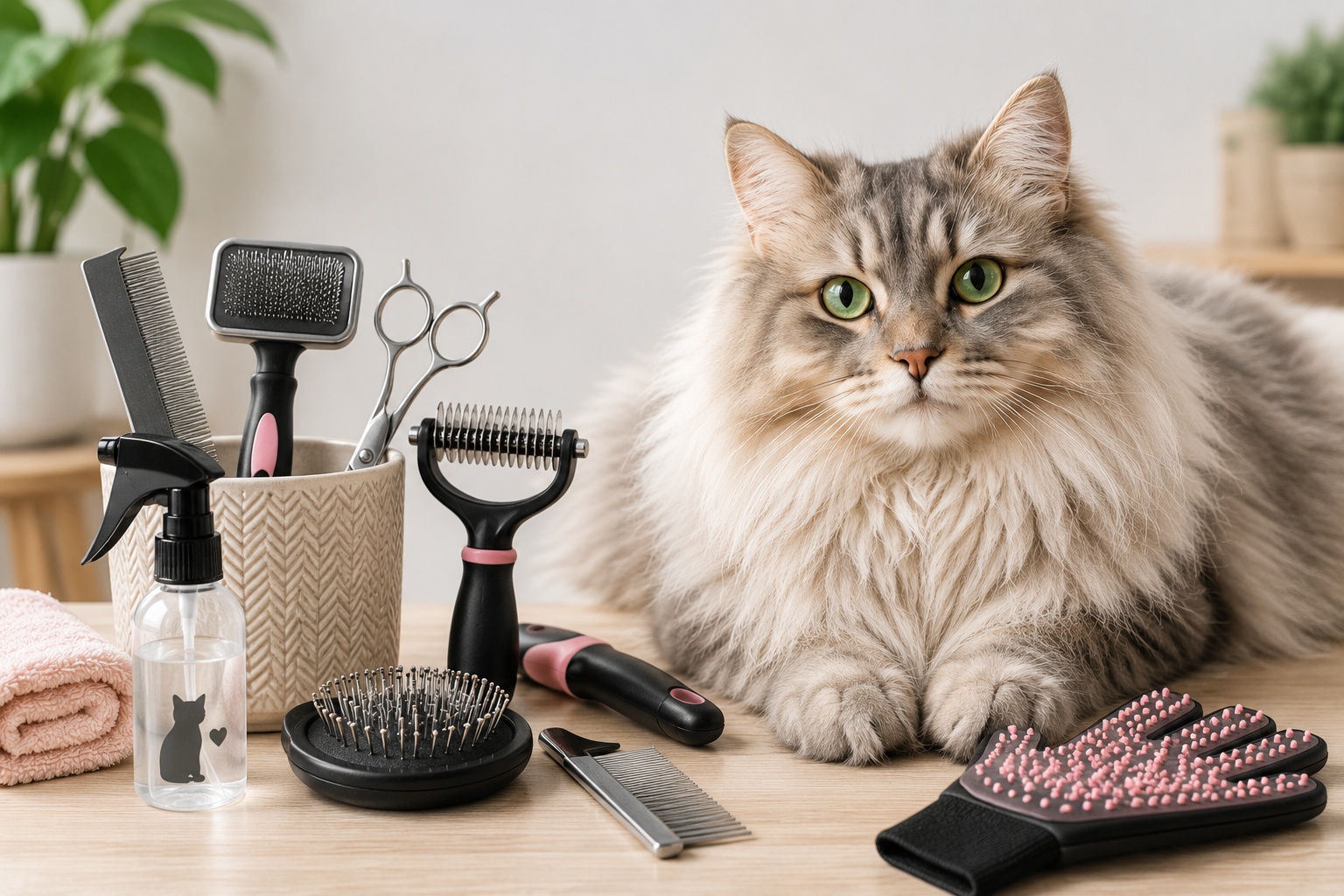
A slicker brush has fine, closely-spaced wire bristles set at an angle on a flat or slightly curved pad. It is the most important single tool for long-haired cat grooming — used at every grooming session to remove loose hair, detangle the top coat, and smooth the fur.
How to use it: Work in sections, brushing in the direction of hair growth. Use gentle, short strokes rather than long sweeping strokes — long strokes pull at tangles and cause pain. Work from the ends of the hair upward toward the roots, not from root to tip — this is called “line brushing” and prevents pulling on knots.
What to look for: A slicker brush with a self-cleaning button that retracts the bristles for easy hair removal is a practical feature. Soft-flex slicker brushes (where the pad bends slightly) are gentler on sensitive skin than rigid versions.
2. Wide-Toothed Metal Comb — The Quality Check
After every brush session, run a wide-toothed metal comb through the coat. This is your quality check — if the comb moves smoothly through the coat from root to tip without catching, the coat is genuinely tangle-free. If it catches, there are tangles the slicker brush missed that need addressing.
A metal comb also reaches areas the slicker brush handles less well — under the chin, around the face, between the legs, and in the armpits where mats most commonly form.
What to look for: A comb with both wide and narrow-spaced teeth is versatile — use the wide end for general combing and the narrow end for finer areas around the face and paws.
3. Dematting Comb or Splitter
Despite best intentions, mats happen — particularly in the armpits, behind the ears, and around the collar area. A dematting comb has serrated, curved blades that cut through mat fibres while you work them loose, rather than pulling the entire mat.
How to use it: Hold the mat firmly at its base (against the skin) with your fingers to prevent pulling, then work the dematting comb through the outer edges of the mat — never start in the centre. Work patiently from the outside in. Never cut a mat with scissors — the risk of cutting skin is too high. If a mat is too tight to work through with a dematting comb, a professional groomer is the safer option.
4. Undercoat Rake
Long-haired cats have a dense undercoat beneath the longer outer coat. During seasonal shedding — typically spring and autumn — this undercoat loosens and, without removal, becomes the foundation of mat formation. An undercoat rake has long, widely-spaced teeth designed to reach through the top coat and pull out loose undercoat.
When to use it: During shedding season, use the undercoat rake before the slicker brush — it removes the bulk of the loose undercoat, making the subsequent brushing session far more effective.
What to look for: A rotating-tooth undercoat rake is gentler than a fixed-tooth version as the teeth turn with the coat rather than dragging through it.
5. Finishing Comb or Bristle Brush
After the main grooming session — slicker brush followed by metal comb — a soft bristle brush or finishing comb is used to smooth, polish, and separate the coat. This final step distributes natural oils along the hair shaft, giving the coat its healthy sheen, and separates individual hairs so they lie correctly rather than clumping together.
For show-quality grooming of breeds like Persians, a fine-toothed finishing comb creates the characteristic fluffy, separated coat appearance. For everyday home grooming, a soft bristle brush achieves a similar result with less precision required.
6. Grooming Scissors — With Extreme Caution
A pair of blunt-ended grooming scissors is useful for trimming the fur around the paws (where long fur traps litter), around the rear end (hygiene trimming), and around the face if needed.
Critical rule: Never use scissors on mats. The skin beneath a mat is often folded or pulled tight, and cutting into a mat almost inevitably means cutting skin. Use scissors only on visible, loose fur in accessible areas, with blunt tips pointing away from the body at all times.
Grooming Tools by Breed
Different long-haired breeds have different coat textures that respond best to specific tools:
| Breed | Coat Type | Primary Tool | Key Challenge |
|---|---|---|---|
| Persian | Dense, fine, silky | Slicker brush + wide comb | Mats extremely easily — daily brushing essential |
| Maine Coon | Dense, semi-long, shaggy | Undercoat rake + slicker | Heavy seasonal shedding |
| Ragdoll | Semi-long, silky, low-mat | Slicker brush + comb | Easier than Persian but still needs 3x weekly |
| Norwegian Forest Cat | Dense double coat | Undercoat rake + slicker | Waterproof coat resists products — brush only |
| Birman | Semi-long, silky | Slicker brush + comb | Mat-prone around collar and legs |
| Siberian | Triple coat, dense | Undercoat rake + slicker | Very heavy shedding seasons |
Building a Long-Haired Cat Grooming Routine
Daily (for Persians and heavily mat-prone breeds):
- Quick slicker brush through entire coat — 5 minutes
- Metal comb check of high-risk areas (armpits, behind ears, under chin)
3–4 times weekly (for Maine Coons, Ragdolls, Birmans):
- Full slicker brush session
- Metal comb quality check
- Finishing brush
Weekly (during non-shedding season):
- Undercoat rake through body coat
- Full slicker and comb session
- Check and trim paw fur if needed
During shedding season (all long-haired breeds):
- Increase brushing to daily
- Lead every session with the undercoat rake
- Consider a professional de-shedding treatment from a groomer — see our dog grooming prices guide for what professional grooming costs and our how often should you groom your dog guide for frequency guidance that applies equally to cats
Making Grooming Positive — Especially for Cats Who Resist
Many cats — particularly those not introduced to grooming as kittens — resist handling and brushing. Forcing the issue is counterproductive and creates lasting negative associations.
Build tolerance gradually:
- Start with very short sessions — even 30 seconds of brushing with a treat reward counts as a win
- Use high-value treats reserved exclusively for grooming sessions
- Work from the areas your cat most enjoys being touched — usually the head and neck — before moving to more sensitive areas
- End every session before your cat reaches their tolerance limit — ending on a good note is more valuable than completing a perfect brush
For cats who are genuinely resistant: A professional groomer experienced with anxious cats, or a vet-performed groom under sedation, is a better option than a daily battle that makes both of you miserable. Our how to get an aggressive cat to the vet guide covers managing anxious cats in professional settings.
When home grooming between professional visits becomes difficult or mats are already established, our trusted grooming partner PawCareBuddy offers professional cat grooming services including de-matting, coat tidying, and full grooming packages.
Long-Haired Cat Grooming Tools — FAQ
How often do I need to groom a long-haired cat? Persian and other heavily mat-prone breeds need daily brushing. Most other long-haired breeds need 3–4 times weekly as a minimum, increasing to daily during shedding season.
My cat has a mat — can I cut it out with scissors? No — the skin beneath a mat is often pulled tight and folded, making cutting extremely risky. Use a dematting comb to work through the mat from the outside in, or take your cat to a professional groomer. If the mat is very tight or close to the skin, a vet groom under sedation is the safest option.
What is the most important grooming tool for a long-haired cat? A good quality slicker brush used consistently. No other tool compensates for inadequate brushing, and a slicker brush used correctly at every session is the foundation of a healthy long coat.
Should I bathe my long-haired cat? Some long-haired breeds benefit from occasional bathing — particularly Persians whose fine coats can become oily. Most cats do not enjoy bathing and it is rarely necessary if brushing is consistent. When bathing is needed, ensure the coat is completely mat-free before wetting — water causes mats to tighten dramatically.
Can I use dog grooming tools on my cat? Some tools — slicker brushes, metal combs — work for both cats and dogs. Avoid dog-specific deshedding tools that are sized for larger animals and generate more force than a cat’s skin can comfortably handle. Cat-specific versions of these tools are appropriately sized and gentler.
Menu placement: CAT → Cat Care and Grooming Slug: longhaired-cat-grooming-tools
Also read: How to Groom a Dog at Home — Step by Step | Best Dog Grooming Tools for Home Use | How Often Should You Groom Your Dog | Dog Grooming Prices — What to Expect