

You just brought your puppy home. They are adorable, chaotic, and absolutely not trustworthy with your furniture, your carpets, or your sleep schedule. Someone told you to get a crate. You got a crate. Now you are staring at it wondering how to actually make this work — because the moment you put the puppy inside and walked away, the noise that followed was genuinely alarming.
How to crate train a puppy is one of the most searched dog training topics in the world — and for good reason. Done correctly, crate training gives your puppy a safe, comfortable den they genuinely love. Done incorrectly, it creates a cycle of stress and crying that makes everything harder. This guide gives you the complete, step-by-step process, the correct timeline, how to stop the crying, and everything you need to know about potty training alongside crate training.
Training high energy dogs has never been easier with this guide!
Why Crate Training Works — The Psychology Behind It
Before getting into the steps, understanding why crate training works makes the process significantly easier to follow correctly.
Dogs are den animals. In the wild, canines seek out small, enclosed spaces to sleep, rest, and feel safe. A crate that is introduced correctly taps into this instinct — it becomes your puppy’s den, their safe space, the place they choose to go when they want to rest or decompress.
The key word is correctly. A crate used as punishment, introduced abruptly, or made to confine a puppy for longer than their bladder allows becomes associated with stress and distress — the opposite of a den. The steps below build positive association systematically, which is why the process takes days to weeks rather than hours.
Crate training also accelerates potty training dramatically. Puppies instinctively avoid soiling their sleeping area — which means a correctly sized crate teaches your puppy to hold their bladder between toilet trips, building the physical and behavioural habit that leads to a fully house-trained dog.
What You Need Before You Start
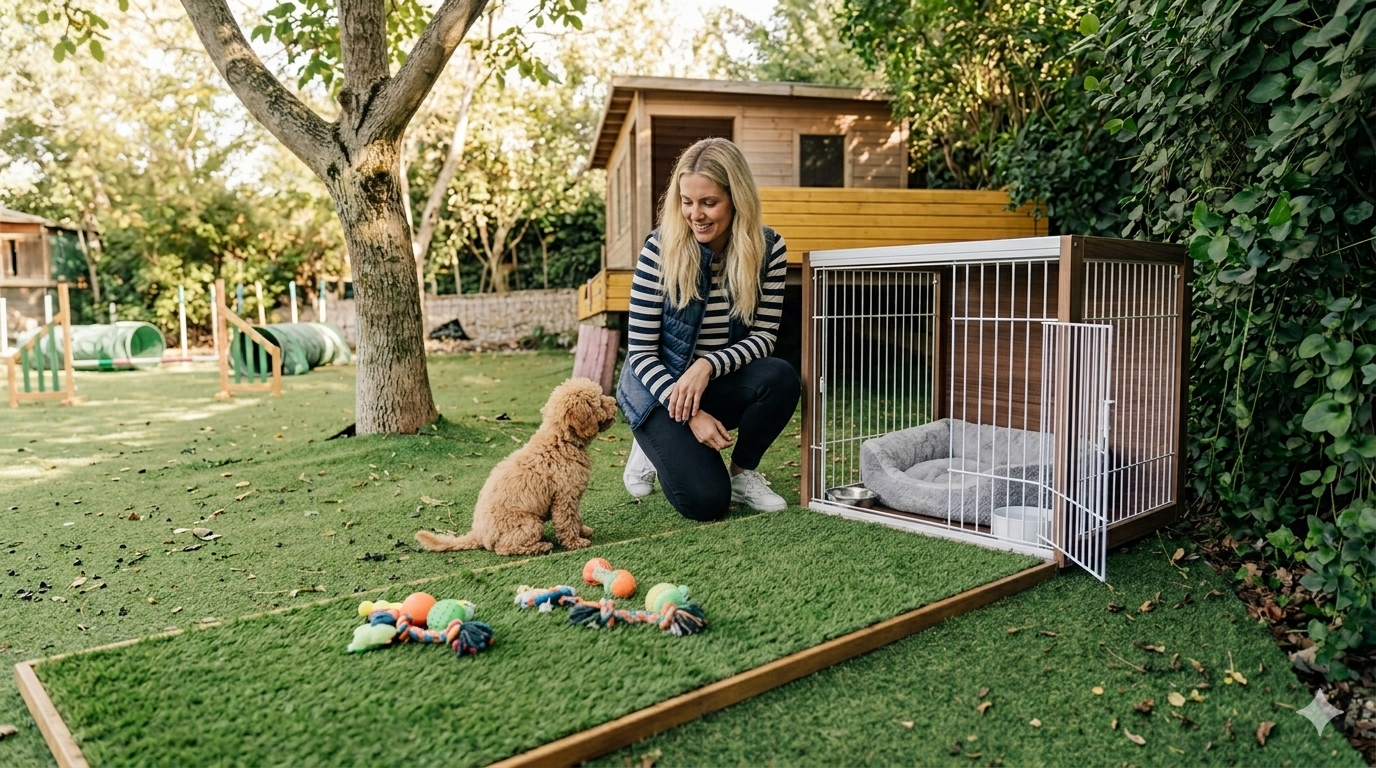
The right crate size: This is critical for potty training success. The crate should be large enough for your puppy to stand up, turn around, and lie down comfortably — and no larger. A crate that is too large allows your puppy to use one end as a bathroom and the other as a bedroom, completely defeating the potty training benefit.
If you are buying a large crate for a breed that will grow significantly, buy a crate with a divider panel — this allows you to reduce the usable space now and expand it as your puppy grows, without buying multiple crates.
Soft, comfortable bedding: A washable bed or mat inside the crate makes it comfortable and appealing. Avoid expensive bedding during early training — accidents will happen.
Food-stuffed toys: A frozen Kong or similar toy filled with puppy-safe filling is one of the most effective crate training tools available. It occupies your puppy during the critical first few minutes in the crate and creates a strong positive association with being inside.
Recommend a puppy Kong or similar stuffable toy.
High-value treats: Small, soft treats your puppy does not get at any other time. These are your training currency for crate introduction.
A crate cover or blanket: Covering three sides of the crate creates a darker, more den-like environment that many puppies find calming. It also reduces visual stimulation that can trigger barking.
How to Crate Train a Puppy — Step by Step
Step 1 — Introduce the Crate as a Neutral Object (Day 1)
Place the crate in a room where your family spends time — not isolated in a back room. Put comfortable bedding inside, leave the door open, and let your puppy explore completely freely. Do not push them in. Do not close the door. Just let it exist as part of the environment.
Toss a few treats near the crate door, then just inside the doorway, then further inside. Let your puppy choose to investigate at their own pace. Some puppies walk straight in on the first day. Others take several sessions. Both are fine.
If your puppy shows no interest, try placing their food bowl just inside the door during meal times.
Step 2 — Feed Meals Inside the Crate (Days 1–3)
Once your puppy is comfortable approaching the crate, begin placing their food bowl just inside the doorway, then progressively further inside over subsequent meals. By day 2 or 3, your puppy should be stepping fully inside to eat.
During this phase, do not close the door. The goal is simply making the inside of the crate the location of good things — food, treats, positive attention.
Step 3 — Begin Closing the Door Briefly (Days 3–5)
Once your puppy is eating comfortably inside the crate, close the door gently while they eat. Open it before they finish. Gradually extend the time the door is closed — first for the duration of a meal, then for a minute or two afterward while you sit nearby.
If your puppy whines when the door is closed, you have moved too quickly. Go back a step and rebuild at a slower pace.
Step 4 — Extend Time Inside With You Present (Days 5–7)
Begin having your puppy spend short periods in the crate — 5 to 15 minutes — with the door closed while you remain in the room. Give them a frozen Kong or chew to occupy them during this time.
Build up the duration gradually. The goal by the end of the first week is a puppy that can settle in the crate for 20 to 30 minutes while you are nearby, without significant distress.
Step 5 — Leave the Room Briefly (Week 2)
Once your puppy settles for 30 minutes with you present, begin leaving the room for short periods — first 5 minutes, then 10, then 20 — returning calmly and releasing your puppy without drama.
This is the phase where many owners move too quickly. The gradual process of building duration and distance simultaneously is what creates lasting, reliable crate acceptance.
Step 6 — Nighttime Crating (Week 1 Onwards)
Nighttime is when most crate training challenges appear — and where the most common mistakes are made.
Place the crate in your bedroom — at least initially. A puppy that can hear and smell you nearby settles significantly faster than one isolated in another room. Once they are sleeping through the night reliably, you can gradually move the crate to its permanent location.
The correct nighttime approach:
- Take your puppy for a toilet trip immediately before crating
- Give a frozen Kong or chew to occupy initial settling time
- Expect one to two overnight toilet trips for puppies under 16 weeks — set an alarm rather than waiting for whining
- Age in months = rough number of hours they can hold their bladder overnight, plus one
The crying it out question: Allowing a very young puppy to cry for extended periods causes genuine distress and damages your developing relationship. However, brief protest barking — settling within 10 to 20 minutes — is normal and not harmful. The distinction is duration and intensity: brief protest that fades is manageable. Sustained escalating distress is not, and needs a different approach.
How to Stop a Puppy Crying in the Crate
This is the number one crate training challenge. Understanding why the crying happens helps you address it correctly.
Cause 1 — Moving too fast: The most common cause. If your puppy is crying when you leave the room, you have skipped steps. Go back to Step 4 and rebuild at a slower pace.
Cause 2 — Wrong crate size: A crate that is too large does not feel like a den — it feels like a room. Add a divider or reduce the space.
Cause 3 — Bladder urgency: A puppy that needs to toilet will escalate from whining to distress very quickly. If this is happening at a specific time overnight, set an alarm 30 minutes earlier to pre-empt the urgency.
Cause 4 — Hunger: Very young puppies need feeding more frequently than adults. If your puppy is crying and it has been more than 4 hours since their last meal, hunger is a factor.
Cause 5 — Insufficient exercise and stimulation: A puppy that has not had adequate physical play and mental stimulation before being crated will not settle. Exercise and play before every crate session is non-negotiable.
What not to do when a puppy cries:
- Do not let them out the moment they cry — this teaches them that crying opens the door
- Do not yell or scold — this adds your attention (reinforcing the crying) and creates stress
- Do not give in to crying and bring them to bed — unless you are happy for this to be the permanent arrangement
What to do: Wait for a brief pause in the crying — even 5 seconds — and then calmly release them. This teaches the puppy that quiet, not noise, opens the door.
Crate Training and Potty Training Together
Crate training and potty training work together — and understanding how they interact makes both significantly faster.
The principle: dogs instinctively avoid soiling their sleeping area. A correctly sized crate uses this instinct to build bladder control.
The potty training schedule alongside crating:
- Take your puppy outside immediately when they come out of the crate — every single time
- Praise and reward generously when they toilet outside
- A puppy that toilets outside gets supervised free time. A puppy that does not goes back in the crate for 15 minutes and you try again
- Never give unsupervised free time to a puppy that has not recently toileted outside
How long can a puppy be in a crate?
| Age | Maximum Crate Time During Day |
|---|---|
| 8–10 weeks | 1 hour maximum |
| 10–12 weeks | 2 hours maximum |
| 3 months | 3 hours maximum |
| 4 months | 4 hours maximum |
| 5–6 months | 4–5 hours maximum |
| Over 6 months | Up to 6 hours |
These are absolute maximums — not targets. The crate is a management and training tool, not a storage facility. A puppy that spends most of their waking hours in a crate is not being trained — they are being neglected.
Crate Training When You Work Full Time
Many owners need to crate train while working. This requires a slightly different approach because puppies under 6 months genuinely cannot hold their bladder for a full workday.
The practical solutions:
- A dog walker or pet sitter for a midday toilet break and interaction
- A puppy playpen attached to the crate — allows the puppy to exit the crate to a toilet pad area within the pen
- A trusted neighbour, friend, or family member checking in midday
A puppy that is left in a crate for 8 hours while you work will have accidents — not because they are not trained, but because their physiology does not allow them to wait that long. Plan for midday support until your puppy is at least 5 to 6 months old.
As we covered in our guide to how long dogs can be left alone, the age-appropriate alone time limits apply equally to crated time.
How Big Should a Puppy Crate Be?
Getting the size right is one of the most important practical decisions in crate training.
The rule: Your puppy should be able to stand up fully without their head touching the top, turn around comfortably, and lie on their side fully extended. Nothing more.
Too large is a problem: A puppy in a too-large crate can toilet in one corner and sleep comfortably far away from it — removing the potty training benefit entirely.
For growing breeds: Buy a crate with a divider panel sized for your dog’s adult dimensions. Use the divider to keep the usable space appropriately small now, and expand it in stages as your puppy grows.
Wire vs plastic crates:
- Wire crates offer better ventilation and visibility, allow a cover to be draped over them, and typically come with divider panels. Best for most puppies.
- Plastic airline crates feel more den-like due to enclosed sides — better for puppies that find wire crates over-stimulating.
Recommend a wire puppy crate with divider panel.
Common Crate Training Mistakes
Mistake 1 — Using the crate as punishment. The moment a crate is associated with punishment, your puppy will resist going in. The crate must always be positive — never a place they are sent when you are angry.
Mistake 2 — Leaving the puppy too long too soon. Build up duration gradually. A puppy that regularly spends more time in the crate than their bladder allows will have accidents and develop negative associations.
Mistake 3 — Making departures and arrivals dramatic. Prolonged emotional goodbyes before crating increase anxiety. A calm, matter-of-fact approach — puppy in, door closed, you leave — produces significantly less distress than an emotional ritual.
Mistake 4 — Giving up too early. The first few nights of crate training are almost always the hardest. Many owners give up on night 3 when they are actually two days away from breakthrough. Consistency across a full 2 to 3 week period produces a puppy that settles reliably.
Mistake 5 — Not exercising the puppy before crating. A puppy with pent-up energy will not settle in a crate regardless of how well the crate has been introduced. A play session or active walk before every crate period is essential.
FAQ — How to Crate Train a Puppy
Q: How long does it take to crate train a puppy? A: Most puppies accept the crate comfortably within 1 to 2 weeks of consistent, positive introduction. Reliable nighttime settling without significant crying typically takes 2 to 4 weeks. Some puppies accept it faster — particularly if introduced very young with a calm, consistent approach.
Q: Should I let my puppy cry it out in the crate? A: Brief protest that fades within 10 to 20 minutes is manageable. Prolonged, escalating distress should not be ignored — it indicates either that the crate introduction moved too quickly, that a bladder break is needed, or that another need is unmet. Identify the cause rather than simply waiting it out.
Q: Can I crate train an older puppy or adult dog? A: Yes — the process is identical, just with a dog that has a longer attention span and better bladder control. Older dogs often adjust to the crate faster than young puppies.
Q: Should the crate be in my bedroom at night? A: For the first 1 to 4 weeks — yes. Proximity to you dramatically reduces nighttime crying and speeds up the settling process. Once your puppy is sleeping reliably, you can gradually move the crate to its permanent location.
Q: What do I put in the crate with my puppy? A: Comfortable bedding, a frozen stuffed Kong or long-lasting chew for initial settling, and something that smells like you — a worn t-shirt or similar. Avoid toys with parts that could be chewed off and swallowed.
Q: How do I stop my puppy from pooping in the crate? A: Ensure the crate is sized correctly — no larger than needed. Take your puppy to toilet immediately before crating. Make sure the crate time is appropriate for their age. If accidents are happening despite correct sizing and timing, a vet check is worthwhile to rule out a digestive issue.
Conclusion
How to crate train a puppy comes down to one principle above everything else: build positive association gradually, never move faster than your puppy’s confidence allows, and be consistent across every single interaction with the crate. The process takes weeks — not days — when done correctly, and the result is a dog that genuinely loves their crate for life.
A well-crate-trained puppy has a safe space of their own, a house-trained future, and an owner who can leave the house confidently. Every day of patient, positive crate training is an investment in years of easier, calmer dog ownership.
Also read: How to stop a dog from barking at night | How long can a dog be left alone? | How often should I bathe my dog? | Best food for dogs with sensitive stomachs | Why does my dog eat grass? | How long do indoor cats live?