
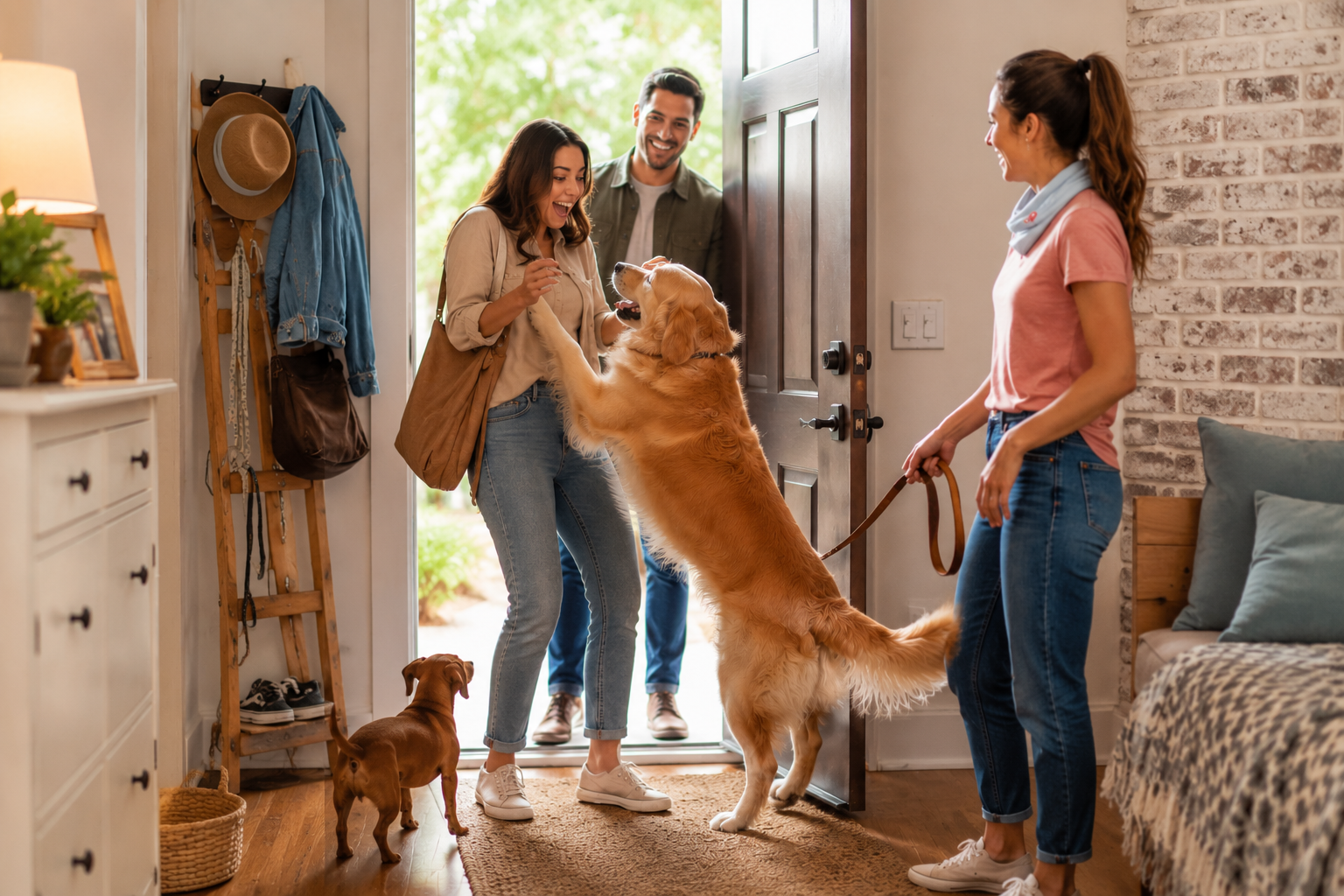

Your guests arrive at the front door. You open it with a smile. And before a single word is exchanged, your dog has launched themselves at your visitor like a heat-seeking missile — paws on shoulders, tongue aimed at face, tail a blur. Your guest is startled. You are embarrassed. Your dog is absolutely delighted.
Why does my dog jump on guests? It is one of the most common behaviour problems dog owners deal with — and one of the most misunderstood. Most owners try to stop the jumping without understanding why it happens, which is why the problem persists despite years of “no” and “down” and “off.” This guide explains every real reason dogs jump on people, what the jumping actually communicates, and the exact methods that stop it reliably — not just in the moment, but permanently.
Why Does My Dog Jump on Guests? — The Short Answer
Before getting into the specific reasons, the most important thing to understand is this: jumping on people almost always starts as a greeting behaviour — and it continues because it has been reinforced.
From the day your dog was a tiny, adorable puppy, jumping up resulted in attention. People bent down to greet them. People laughed. People petted them. People made eye contact and said their name. Every one of those responses told your puppy: jumping works. It gets me what I want.
Your dog is not jumping on guests to be dominant, to misbehave, or to embarrass you. They are doing exactly what experience has taught them produces interaction and attention. Understanding this changes your entire approach to solving it.
7 Real Reasons Why Your Dog Jumps on Guests
Reason 1 — Excitement and Arousal
The most common reason by far. Guests arriving at the front door is one of the highest-arousal events in a dog’s day — a new person, new smells, new sounds, the energy of anticipation.
A dog in a state of high arousal has significantly reduced impulse control. The same dog that sits beautifully in the garden will completely lose their manners at the front door because the arousal level has temporarily overridden their training. This is not disobedience — it is neurology. A highly aroused dog literally cannot access the same level of self-control as a calm one.
This is why so many owners report that their dog “knows” the command but ignores it when guests arrive. The dog does know it — but the arousal level is preventing access to that knowledge in the moment.
Reason 2 — Attention Seeking
Dogs jump to get interaction. If jumping at guests has — even once, even occasionally — resulted in the guest bending down, making eye contact, saying the dog’s name, or pushing the dog away with their hands, the behaviour has been reinforced.
Intermittent reinforcement — where a behaviour is rewarded sometimes but not others — actually makes behaviour more persistent, not less. A dog that gets attention for jumping every third attempt will jump more insistently than one that is always rewarded, because they have learned to persist through the failures.
Reason 3 — Greeting Behaviour
In dog-to-dog communication, face-to-face contact and sniffing around the face and head is a normal greeting behaviour. Dogs naturally want to reach a person’s face — and since most people are significantly taller than dogs, jumping is the most direct route.
Your dog is not being aggressive or obnoxious. From their perspective, they are performing a completely natural, socially appropriate greeting. They just have not learned yet that humans find this less charming than other dogs do.
Reason 4 — Lack of an Alternative Behaviour
Many owners focus entirely on stopping the jumping without ever teaching their dog what to do instead. “Off” and “no” tell the dog what not to do — but they provide no information about what the correct behaviour is.
A dog that has been taught to sit as a greeting behaviour has an alternative. A dog that has only been told “no” has a command they associate with frustration and confusion but no replacement behaviour to offer. As we covered in our guide to how to teach a dog to sit, sit is an incompatible behaviour — a dog cannot jump and sit simultaneously. Teaching sit as the default greeting is the most effective long-term solution to jumping.
Reason 5 — Inconsistent Rules
This is the reason most training attempts fail. The dog jumps on a guest. The owner says “off.” The guest says “oh it’s fine, I love dogs” and pets the dog anyway. The dog has just received the most powerful possible lesson: jumping on guests is rewarding.
For any jumping training to work, every person who interacts with your dog must apply the same rules consistently. One well-meaning guest who rewards the jumping undoes significant training progress. Inconsistency is the single biggest obstacle to solving jumping behaviour.
Reason 6 — Under-Exercise and Under-Stimulation
A dog that arrives at the front door already at maximum energy — having been inside all day — will jump more intensely and be harder to redirect than a dog that has had adequate physical and mental exercise.
The energy level your dog brings to a greeting directly influences how much impulse control they have available in that moment. A dog that has had a good walk and a mental challenge before guests arrive is genuinely more trainable in the greeting situation than one that has not.
As we covered in our guide to why dogs lick their paws, under-stimulation drives problem behaviours across every area of dog life — and jumping is one of the clearest expressions of pent-up energy seeking an outlet.
Reason 7 — Breed Tendencies
Some breeds are significantly more likely to jump than others — not from poor training but from genetics. Breeds selectively developed for human interaction and companionship — Labrador Retrievers, Golden Retrievers, Boxers, Weimaraners, Vizslas — have higher levels of social arousal around people and therefore more intense greeting behaviour.
This does not mean the jumping cannot be trained. It means that high-arousal, people-focused breeds need more consistent, more thorough training and more management than lower-drive breeds — and that the same level of training that works for a Basset Hound may not be sufficient for a Labrador.
How to Stop Your Dog Jumping on Guests — The Methods That Work
Method 1 — Teach a Sit Greeting as the Default
This is the most effective long-term solution. Instead of trying to eliminate jumping, replace it with an incompatible behaviour your dog can be rewarded for.
How to implement it:
- Teach a reliable sit in low-distraction environments first — as covered in our guide to how to teach a dog to sit
- Once sit is reliable at home, begin practicing it at the front door — before guests arrive
- Practice mock arrivals: have a family member go outside, knock, come in, and ask your dog for a sit before any greeting happens
- Reward the sit heavily — this is the position that produces attention, petting, and praise
- Brief the actual guest: “Please ask him to sit before you greet him and then reward him with this treat”
The sit greeting works because it gives your dog a clear, rewarding alternative to jumping. The dog learns that sitting, not jumping, is what produces the attention they want.
Recommend a dog treat pouch or a small pot of high-value treats by the front door.
Method 2 — Remove All Reinforcement for Jumping
This method works in conjunction with Method 1 — not instead of it. The principle is that any behaviour that produces zero reinforcement will eventually extinguish.
How to apply it: The moment your dog jumps on you or a guest, every person involved turns away completely — no eye contact, no verbal response, no physical response. Turn your back, cross your arms, look at the ceiling. The dog gets absolutely nothing from the jump.
The moment all four paws are on the floor — mark it (“yes!”) and give attention. The dog learns: four paws on the floor gets me what I want, jumping gets me nothing.
The critical element: This must be applied by every person every time. One person who reacts to the jump — even to push the dog away — rewards it. Pushing a dog away with your hands is deeply interactive and physically stimulating — most dogs interpret it as play and jump more.
Method 3 — Manage the Environment While Training
Training takes time. In the meantime, managing the environment prevents your dog from practising the jumping behaviour — which is important because every successful jump reinforces the habit.
Management options:
- Put your dog on a leash before guests arrive — the leash allows you to prevent jumping while still letting your dog greet appropriately
- Use a baby gate to keep your dog behind a barrier while guests enter, then release once the initial excitement has passed
- Ask your dog to go to their bed or mat before the door opens and stay there for the initial greeting — a “place” command is one of the most practical management tools for door behaviour
- Crate your dog briefly during arrivals while you are still in the early stages of training
Recommend a baby gate or dog barrier.
Method 4 — Train the “Off” Command Properly
“Off” is a useful cue — but only if it has been trained properly, not just shouted repeatedly at a jumping dog.
How to train “off”:
- When your dog jumps on you, say “off” once in a calm voice
- Turn away completely — removing all reinforcement
- The moment your dog’s feet hit the floor, immediately say “yes!” and give attention or a treat
- Repeat until your dog reliably puts their feet down when you say “off”
- Then begin asking for a sit immediately after “off” — building the full greeting sequence
The key is that “off” must be paired with a consequence your dog understands. Said without the consistent turn-away and the reward for correct behaviour, “off” is just noise.
Method 5 — Brief Your Guests
This step is consistently overlooked — and it is one of the most practically important.
Your training will not work if your guests do not know the rules. Before your dog approaches, briefly explain:
- “Please don’t pet him until he has all four paws on the floor”
- “If he jumps, turn away and ignore him”
- “When he sits or keeps his paws down, feel free to greet him”
Most guests — once they understand the system — are happy to cooperate. It only takes 15 seconds to explain, and it protects weeks of training from being undone in seconds.
Why Punishment Does Not Stop Jumping
Many owners try kneeing their dog in the chest, stepping on back paws, or shouting when their dog jumps. These approaches are worth addressing because they are commonly recommended — and they do not work for most dogs, and can actively make things worse.
Why they fail:
- The knee technique often injures small dogs and does not reliably deter larger ones
- Any physical interaction — including painful interaction — is still interaction, and for high-arousal dogs, interaction of any kind is reinforcing
- Punishment does not tell the dog what to do instead — it just adds stress and confusion to the greeting
- Dogs that are punished for jumping sometimes redirect their excitement into biting or mouthing, making the behaviour more dangerous rather than less
Positive training approaches — teaching sit, removing reinforcement, rewarding four paws on the floor — consistently produce better long-term results than punishment, with no risk of physical harm or relationship damage.
Why Does My Puppy Jump on Me and Bite?
The combination of jumping and biting is common in puppies and requires a slightly different approach than jumping alone.
Puppy jumping-and-biting during greetings is almost always play and excitement behaviour — not aggression. Puppies play with their littermates using their mouths, and they generalise this to humans if not taught otherwise.
The approach:
- The same turn-away method applies — any jumping or mouthing results in all interaction stopping completely
- A sharp “ouch” or “too bad” before turning away communicates that the behaviour ended the game
- Redirect to appropriate toys — giving the puppy something acceptable to put their mouth on during greetings
- End the greeting session entirely for 30 to 60 seconds if jumping and biting continues — remove yourself from the room if necessary
Consistency across every greeting, from every family member and guest, is even more important with puppies — the habits formed in puppyhood persist into adulthood. As we covered in our guide to how to crate train a puppy, the patterns you establish in early puppyhood shape behaviour for the dog’s lifetime.
Quick Reference — Jumping Solutions by Situation
| Situation | Best Approach |
|---|---|
| Dog jumps on guests at the door | Sit greeting training + leash management during arrivals |
| Dog jumps on everyone all the time | Remove all reinforcement + teach sit as default greeting |
| Dog only jumps on some people | Those people are reinforcing the jumping — brief all guests |
| Puppy jumping and biting | Turn away + ouch + end session + redirect to toy |
| Dog too excited to respond to sit | Pre-arrival exercise + leash at door + lower arousal first |
| Dog jumps on walks | Same method — stop walking, wait for four paws, continue |
FAQ — Why Does My Dog Jump on Guests?
Q: Why does my dog jump on guests but not on me? A: Guests are higher arousal triggers than familiar family members — they are new, exciting, and unpredictable. Dogs also often have more established greeting rules with owners. If guests have previously rewarded the jumping (even once), that reinforcement is driving the behaviour specifically with visitors.
Q: Why does my dog jump on me when I come home? A: Your arrival is one of the most exciting events in your dog’s day. If jumping at homecoming has ever produced attention — even negative attention like “down, down, stop” — the behaviour has been reinforced. Apply the same turn-away method at homecomings: come in calmly, ignore until four paws are on the floor, then greet warmly.
Q: My dog knows sit but ignores it when guests arrive. Why? A: High arousal temporarily reduces impulse control and access to trained behaviours. Your dog is not being defiant — they are overwhelmed by excitement. Solutions: practice the sit greeting specifically at the front door in low-arousal conditions before expecting it to work in high-arousal ones. Reduce arousal with pre-arrival exercise. Use a leash to manage behaviour while the dog’s training catches up to their excitement level.
Q: Will my dog ever stop jumping on its own? A: Unlikely without training. Jumping that is reinforced — even intermittently — will persist. Some dogs naturally calm down with age and reduced arousal, but this takes years and is not reliable. Active training produces results in weeks.
Q: Should I let guests greet my dog if they are jumping? A: No — any greeting that happens while jumping is occurring reinforces jumping. Ask guests to wait until four paws are on the floor, then greet. Even one greeting that happens during jumping sets training back significantly.
Q: How long does it take to stop a dog jumping on guests? A: With consistent application of the sit greeting and zero reinforcement for jumping across all people — most dogs show significant improvement within 2 to 4 weeks. A fully reliable sit greeting with new guests in high-arousal situations takes 6 to 12 weeks of consistent practice.
Conclusion
Why does my dog jump on guests? Because jumping has always worked — it produced attention, interaction, and engagement from the very first time they tried it. And because no one has consistently taught them a better alternative.
The solution is not punishment and not endless repetition of “off.” It is teaching a sit greeting as the default, removing every scrap of reinforcement for jumping from every person every time, managing the environment while training, and briefing guests so your hard work is not undone at the front door.
Dogs jump because they are social, excited, and affectionate. Channel that energy into a calm sit — and the dog that was launching itself at your guests becomes the dog that sits politely waiting to be greeted. That transformation happens faster than most owners expect. It just requires consistency from every person in the equation.
Also read: How to teach a dog to sit | How to stop a dog from pulling on the leash | How to crate train a puppy | How to stop a dog from barking at night | Why does my dog lick his paws? | How long can a dog be left alone?