
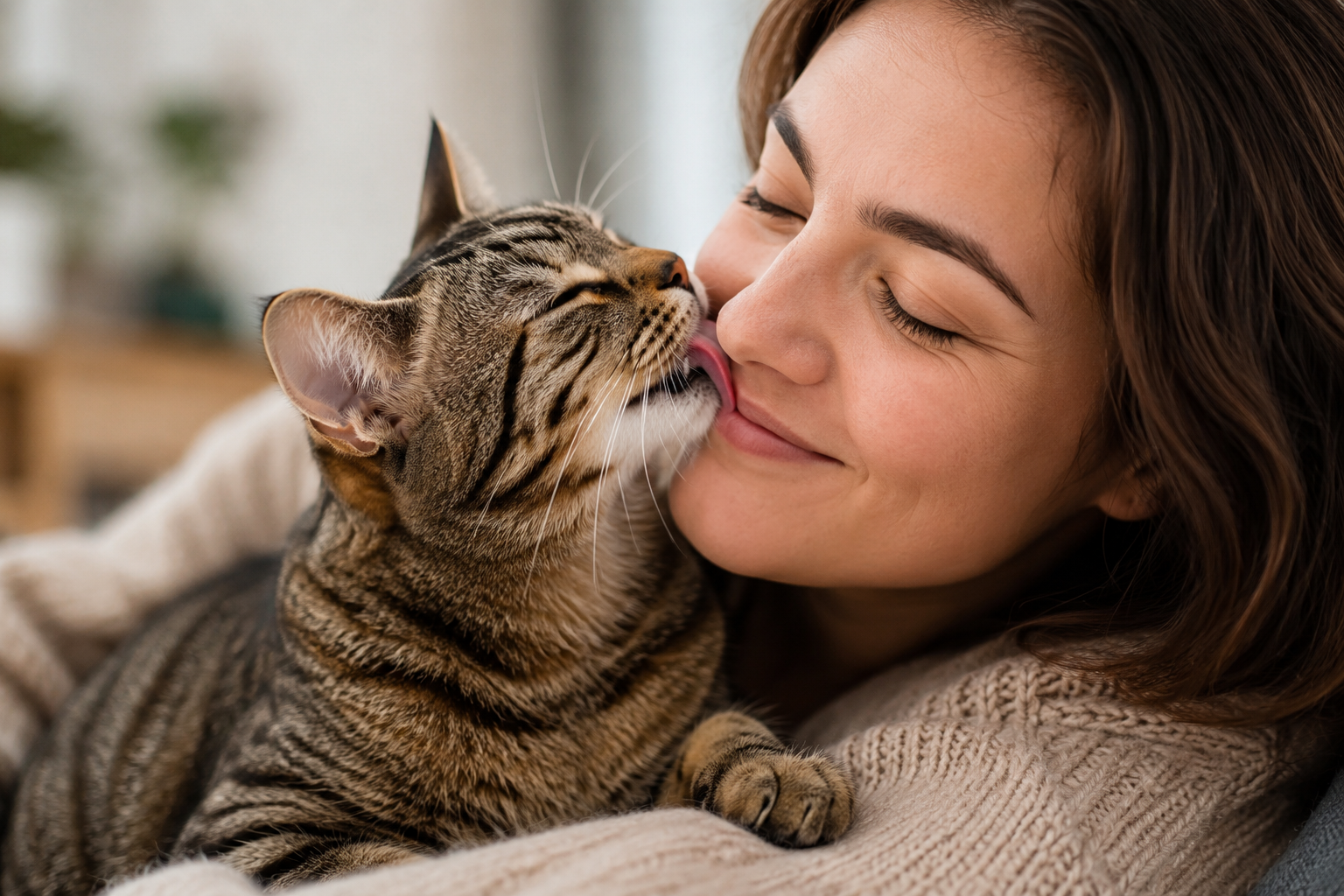

You are relaxing on the sofa when your cat climbs up beside you, settles in, and starts methodically licking your arm. Or your hand. Or your face — with that rough little tongue that feels somewhere between sandpaper and affection. You are flattered, slightly confused, and maybe a little sore.
Why does my cat lick me? It is one of the most common questions cat owners ask — and the answer is more layered and more meaningful than most people realise. Your cat is not licking you randomly. Every single time they do it, they are communicating something specific. Once you understand what that something is, you will never feel that rough little tongue on your hand the same way again.
Why Do Cats Lick People? The Short Answer
Licking is one of the most fundamental behaviours in a cat’s communication toolkit. From the first hours of life, kittens are licked by their mothers — to stimulate breathing, to clean them, and to bond with them. That association between licking and safety, love, and comfort is hardwired into every cat from birth.
When your cat licks you, they are drawing on that same deep instinct. They are not doing something strange — they are doing something deeply natural. The key is understanding which reason applies in any given moment, because cats lick for several different reasons depending on context.
10 Reasons Why Your Cat Licks You
Reason 1 — They Are Grooming You Because They Love You
This is the most important reason — and the one that should make you feel genuinely good about your relationship with your cat.
In the cat world, mutual grooming — called allogrooming — is reserved exclusively for cats that share a close social bond. Cats do not groom just anyone. They groom the cats and the people they consider family. When your cat licks your arm, your hand, or your face, they are performing the same act of care and connection that bonded cats perform for each other.
Your cat is grooming you because they love you and consider you part of their social group. That rough tongue on your skin is the feline equivalent of a hug.
Reason 2 — They Are Marking You as Theirs
Cats have scent glands throughout their body — and licking is one way they deposit their scent onto the things and people that matter to them.
When your cat licks you, they are leaving their scent on you. To other cats, this is a clear signal: this person belongs to me. This is not possessive in a negative sense — it is your cat’s way of saying you are part of their world, their territory, their family.
This is also why cats will often lick you after you have been somewhere new, handled another animal, or come home smelling of unfamiliar things. They are reclaiming you — restoring your scent to something familiar and reassuring.
Reason 3 — They Are Showing Affection
Not all cat affection looks like sitting on your lap. For many cats — particularly those that are not huge fans of being held — licking is the primary way they express love and closeness.
If your cat licks you and purrs at the same time, this is one of the clearest displays of contentment and affection a cat can offer. As we covered in our guide to why cats stare at you — cats have their own language for love, and it looks very different from a dog’s version of it. Licking is part of that language.
Reason 4 — They Enjoy the Taste of Your Skin
This one is less romantic — but entirely true. Human skin carries salt from sweat, as well as residues from lotions, food, and other substances that cats find genuinely interesting.
Your cat may lick your hand after you have been cooking, lick your face after you have been exercising, or focus on specific spots that carry a taste or scent that appeals to them. It does not always mean something deep and meaningful — sometimes your cat just thinks you taste interesting.
This is especially common with hands and fingers. If your cat always gravitates toward licking your hands specifically, consider what your hands have recently touched. As we discussed in our guide to why cats stop eating — cats have an extraordinarily well-developed sense of smell and taste that drives many of their behaviours.
Reason 5 — They Are Seeking Attention
Cats are clever communicators. If your cat has learned that licking your arm or face reliably gets your attention — a reaction, a laugh, a pet, a conversation — they will use it deliberately.
This is especially common in cats that lick you when you are busy, distracted, or looking at your phone. The lick is not purely affectionate in this case — it is also strategic. Your cat wants your focus, and licking has proven to be an effective way to get it.
The response you give matters. If you react warmly every time your cat licks you, you are reinforcing the behaviour. That is not a bad thing — but it is worth knowing that your cat has figured you out.
Reason 6 — They Are Stressed or Self-Soothing
Licking has a calming, self-soothing function for cats. When cats are anxious or overwhelmed, grooming — including licking people and objects — can serve as a coping behaviour.
If your cat has started licking you more suddenly, consider whether anything has changed in their environment — a new pet, a house move, a change in routine, loud construction nearby. A cat that licks you obsessively or aggressively may be communicating anxiety rather than affection.
This is different from the warm, relaxed licking of a contented cat. An anxious licker tends to be more persistent, more frantic, and harder to redirect. If this behaviour has appeared suddenly and alongside other signs of stress — hiding, changes in appetite, or excessive self-grooming — it is worth mentioning to your vet. As we covered in our guide to why cats sleep so much — sudden behavioural changes always have a reason.
These calming diffusers are perfect for any anxious felines!
Reason 7 — They Are Mothering You
Some cats — particularly those that were very maternal before being spayed, or those with nurturing personalities — will lick their owners as an expression of caregiving.
This is especially common when you are unwell, crying, or unusually still. Your cat senses something is different about you — your smell changes when you are sick, your body temperature shifts, your behaviour is quieter — and their response is to groom you the way a mother cat would care for a kitten that needed attention.
If your cat licks you more when you are sick or upset, this is not coincidence. Your cat is looking after you in the most direct way they know how.
Reason 8 — They Are Being a Kitten Again
Many cats carry behaviours from kittenhood into adult life — particularly behaviours associated with warmth, comfort, and closeness. Kneading is the most well-known example. Licking is another.
A cat that licks you while simultaneously kneading your arm or lap is likely engaging in a comfort behaviour rooted in kittenhood — specifically in the association between their mother, warmth, and safety. The combination of licking and kneading together almost always indicates a cat that feels deeply content and secure.
This is especially common in cats that were separated from their mothers early — they may seek out human substitutes for maternal grooming more intensely than cats that were weaned at the appropriate age.
Reason 9 — Your Cat Licks You Then Bites You — What Does It Mean?
This is one of the most Googled variations of this question — and for good reason. One moment your cat is lovingly licking your hand, and the next they have bitten you. What is happening?
The lick-then-bite sequence is normal cat behaviour and usually means one of two things:
Overstimulation. Cats have a threshold for how much sensory input they can handle. During a grooming session — whether with another cat or with you — they can reach that threshold and react with a bite as a signal to stop. The lick is affectionate. The bite is a boundary. Your cat is saying “I love you, but I am done now.”
Play behaviour. The hunting sequence in cats involves stalking, grabbing, and biting — and play mimics this sequence. Your cat may lick your hand as part of an interaction that escalates into playful biting. In this case, the lick is the calm before the pounce, not a signal of affection.
Pay attention to your cat’s body language in the moments before the bite. A twitching tail, dilated pupils, or a tensing body are signals that the threshold is approaching — and that redirecting to a toy is a good idea before your hand becomes the target.
This cat wand toy is perfect for keeping my cat entertained and engaged!
Reason 10 — It Is Simply Who They Are
Some cats are prolific lickers and some cats barely lick at all — and both are completely normal. Personality, early socialisation, breed tendencies, and individual temperament all influence how much a cat uses licking as a communication tool.
If your cat licks you all the time, you have a cat with a particularly expressive and affectionate grooming personality. If your cat never licks you, it does not mean they love you less — it just means they express affection differently, perhaps through proximity, slow blinks, or head bumps.
As we covered in our guide to how long indoor cats live — understanding your individual cat’s personality and communication style is one of the most meaningful parts of sharing your life with them.
Why Does My Kitten Lick Me So Much?
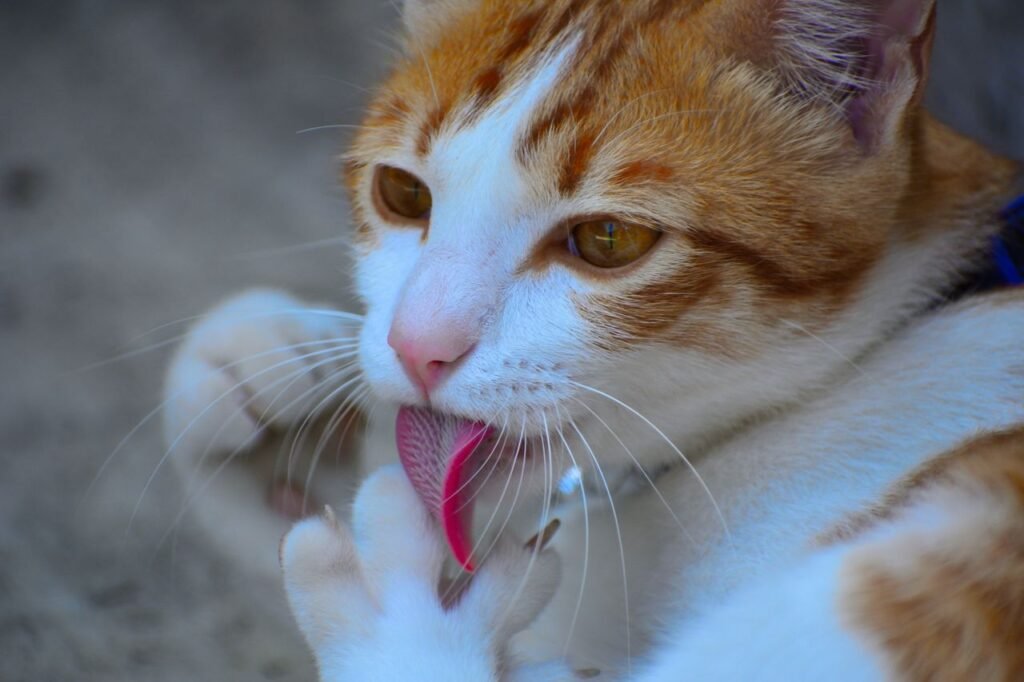
Kittens lick more frequently and more enthusiastically than many adult cats — and it makes sense when you consider what licking means to them.
For a kitten, licking is the primary language of their earliest relationships. Their mother licked them constantly in their first weeks of life — to stimulate them, clean them, and communicate safety. When your kitten licks you, they are extending that same trust and bond to you. You are their person. You are safe.
Kittens also lick as part of learning and exploring their world. Everything is new — every texture, every smell, every sensation. Licking your hand or face is part of how they figure out who you are and what you are made of.
If your kitten licks you constantly — including waking you up to lick your face in the morning — consider it the highest possible compliment. Your kitten has decided you are family, and they are treating you accordingly.
Why Does My Cat Lick My Face Specifically?
Face licking is one of the most intimate things a cat can do — and they reserve it for people they feel completely comfortable with.
Your face carries a concentration of your personal scent — from your breath, your skin, your hair. To your cat, your face is the most “you” part of you. Licking your face is the deepest version of the grooming behaviour — the equivalent of what bonded cats do when they groom each other’s heads and faces, which are the spots they cannot reach themselves.
If your cat specifically targets your face, chin, or forehead — you are being shown a level of trust that most people never get from a cat. The fact that it involves a sandpaper tongue at 3 AM does not make it any less meaningful.
Why Does My Cat Lick Me When I Pet Them?
This is a very common behaviour — and it is almost always a sign of mutual enjoyment and reciprocal bonding.
When you pet your cat, you are effectively grooming them from their perspective. Many cats respond by grooming back — licking your hand or arm — as part of a natural grooming exchange. It is a conversation: you groom me, I groom you. We are bonded. We belong to each other.
It is one of the clearest signs that your cat is not merely tolerating being petted — they are actively enjoying it and choosing to engage back.
Is It Safe to Let Your Cat Lick You?
For most healthy adults, occasional cat licking carries minimal risk. However, there are a few things worth knowing:
- Cat saliva carries bacteria — including Pasteurella and Capnocytophaga — that are generally harmless on intact skin but can cause infection if they enter broken skin, cuts, or mucous membranes. Avoid letting your cat lick open wounds.
- Avoid mouth and eye licking — the bacteria in cat saliva is most concerning near mucous membranes. A cat licking your lips or eyes is worth gently redirecting.
- People with compromised immune systems — those undergoing chemotherapy, living with HIV, or taking immunosuppressant medications — should take extra care and discuss it with their doctor.
- Wash your hands after extended cat licking sessions, particularly before handling food or touching your eyes.
For most cat owners in good health — letting your cat lick your arm or hand is completely fine and carries no meaningful risk.
How to Respond When Your Cat Licks You
| Type of Licking | What It Likely Means | Best Response |
|---|---|---|
| Slow, gentle licking + purring | Affection and bonding | Accept it — you are loved |
| Licking then immediately biting | Overstimulation or play trigger | Redirect to a wand toy |
| Licking your face at night | Hunger or deep affection | Assess whether it’s feeding time |
| Frantic, persistent licking | Possible stress or anxiety | Check for environmental stressors |
| Licking after you return home | Scent-marking and reclaiming you | Completely normal — let them do it |
| Licking your hand while you pet them | Reciprocal grooming exchange | You have a very bonded cat |
| Kneading and licking together | Deep comfort and contentment | Enjoy the moment |
Since licking is really your cat’s version of grooming, giving them a helping hand with their own coat can actually reduce how much they feel the need to groom (and lick you) to begin with. A good deshedding brush removes loose fur before it becomes a hairball problem, and most cats genuinely enjoy the sensation.
When Licking Becomes Excessive — What to Watch For
Occasional and regular licking is healthy and normal. But excessive licking — particularly when it starts suddenly or escalates in intensity — can sometimes indicate something worth investigating.
See your vet if your cat’s licking:
- Started abruptly after a period of not licking you at all
- Is frantic, compulsive, or impossible to redirect
- Is accompanied by excessive self-grooming, hair loss on their own body, or skin irritation
- Appears alongside other behavioural changes — hiding, appetite loss, increased aggression
Compulsive licking in cats can be a sign of anxiety, obsessive-compulsive disorder in cats (yes, this is a real diagnosis), thyroid issues, or skin conditions that are causing irritation. It is always worth investigating if the behaviour feels significantly different from what your cat normally does.
As we outlined in our guide to how often cats should see the vet — sudden behavioural changes of any kind are worth flagging at your next appointment, or sooner if the change is dramatic.
FAQ — Why Does My Cat Lick Me?
Q: Why does my cat lick me so much? A: A cat that licks you frequently is usually a highly affectionate cat that grooms you as an expression of love, bonding, and social connection. It can also mean they enjoy your scent, are seeking attention, or are engaging in comfort behaviour rooted in kittenhood. As long as it is not frantic or obsessive, frequent licking is a very good sign.
Q: Why does my cat lick me and then bite me? A: This is the lick-then-bite sequence — and it usually means your cat has reached their stimulation threshold or has shifted into play mode. The lick is affection or grooming. The bite is a signal to stop or an invitation to play. Watch for a twitching tail or tense body before the bite — those are your warning signs to redirect to a toy.
Q: Why does my cat lick my face? A: Face licking is one of the most intimate grooming behaviours in a cat’s repertoire. Your face carries your strongest personal scent, and a cat that licks your face is treating you the way bonded cats treat each other — grooming the spots that cannot be self-groomed. It is a high compliment.
Q: Why does my cat lick me when I pet them? A: Your cat is engaging in a mutual grooming exchange. From their perspective, petting is grooming — and they are grooming you back. It is one of the clearest signs of a deeply bonded cat-owner relationship.
Q: Why has my cat suddenly started licking me? A: A sudden start to licking can reflect a deepening bond as your cat grows more comfortable with you, a change in your scent they find interesting, or — if it is frantic and accompanied by other changes — a stress response. If everything else seems normal, a sudden start to licking is almost always a positive sign.
Q: Why does my kitten lick me so much? A: Kittens lick frequently because licking is the language of their earliest relationships. Their mother licked them constantly. When they lick you, they are extending that same bond and trust. A kitten that licks you enthusiastically has decided you are family — which is exactly where you want to be.
Conclusion
Why does my cat lick me? Almost always, the answer is love. Your cat is grooming you, bonding with you, marking you, and including you in the most intimate social behaviour in their repertoire. That rough tongue — which feels like it should come with a warning label — is one of the most genuine expressions of affection in the animal world.
Whether your cat licks your hand while you pet them, licks your face at dawn, or turns a licking session into a gentle bite — every variation has meaning. Understanding what your cat is communicating transforms a sometimes-puzzling habit into a window into exactly how much you mean to them.
The next time your cat’s sandpaper tongue finds your arm — let them finish. You have been chosen.
“This post contains affiliate links. As an Amazon Associate, PawCareBuddy earns from qualifying purchases.”
Also read: Why does my cat stare at me? | Why does my cat sleep so much? | Why is my cat not eating? | How long do indoor cats live? | How often should I take my cat to the vet? | Is it normal for cats to drink a lot of water?