
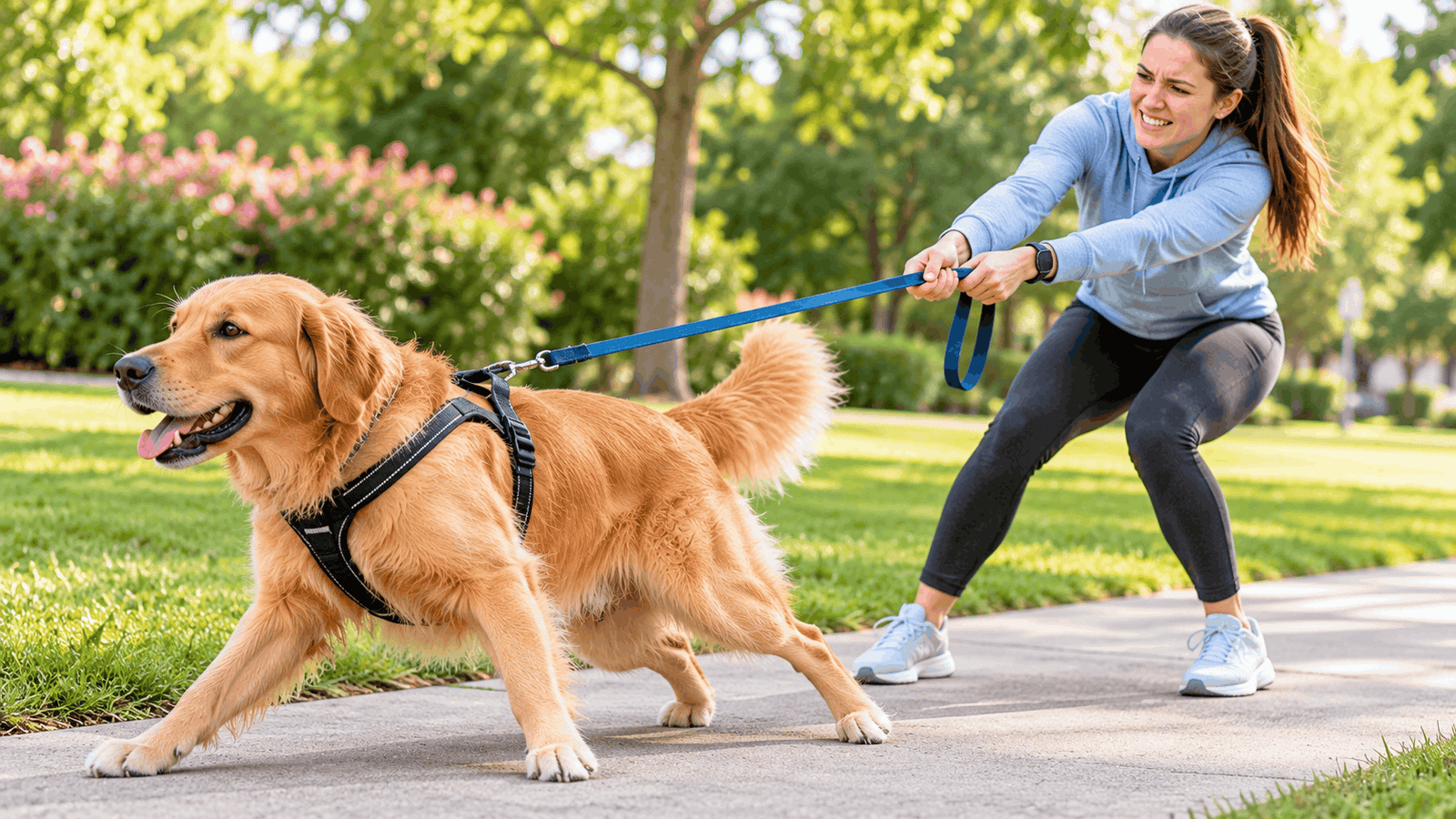

If your dog pulls on the leash every single walk, you are not alone — and your dog is not broken. Leash pulling is one of the most common complaints from dog owners, and it happens for a simple reason: pulling works. Your dog pulls, you move forward, and your dog learns that pulling gets them where they want to go.
The good news is that how to stop a stubborn dog from pulling on leash is a solved problem. It requires consistency, the right technique, and a little patience — but any dog can learn to walk nicely on a lead.
Why Dogs Pull on the Leash
Before fixing the problem, it helps to understand why it happens:
- It has always worked — Every time your dog pulled and you followed, the behaviour was rewarded. Dogs repeat what works.
- Excitement and arousal — The outside world is full of stimulating smells, sights, and sounds. High arousal makes self-control harder.
- Mismatch in pace — Dogs naturally walk faster than humans. Without training, they are always slightly ahead.
- Lack of leash training — Many dogs are never formally taught that a loose lead is what earns forward movement.
Understanding this makes the solution clear: you need to make pulling not work, and make walking on a loose lead consistently rewarding.
What You Need Before You Start
- High-value treats — small, soft, smelly treats your dog goes crazy for. Standard kibble is rarely motivating enough for leash training outdoors.
- A front-clip harness or head halter — these tools do not teach loose leash walking on their own, but they reduce the mechanical advantage your dog has when pulling, making training easier.
- Patience and consistency — loose leash walking takes weeks of consistent practice, not days.
Step-by-Step: How to Stop a Stubborn Dog From Pulling on Leash
Step 1 — The Stop-and-Wait Method (Foundation Technique)
This is the most effective and widely recommended method for teaching loose leash walking:
- Begin walking with your dog on the lead
- The moment your dog pulls — the instant the lead goes tight — stop completely
- Stand still and wait. Do not pull back, do not say anything, do not move forward
- Wait for your dog to turn back toward you, take a step back, or release the tension on the lead
- The moment the lead goes loose — immediately move forward again
- Reward with a treat and praise when your dog is walking beside you with a loose lead
What this teaches: Pulling stops forward movement. A loose lead earns forward movement. Dogs learn this quickly once the rule is applied with absolute consistency.
Be prepared for this to make your first few walks very slow — you may only cover 20 metres in 10 minutes. That is normal and it is progress.
Step 2 — The Turn-and-Go Method (For High Pullers)
If your dog is a strong, persistent puller and the stop-and-wait method is not gaining traction:
- When your dog pulls, instead of stopping — turn and walk in the opposite direction
- Say nothing, just turn calmly and walk the other way
- Your dog must now follow you or be left behind
- When they catch up and the lead is loose, mark with “yes!” and reward
- Repeat every time they pull ahead
This method keeps you moving (less frustrating for both of you) and teaches your dog that pulling means losing the direction they wanted.
Step 3 — Reward Position, Not Just Loose Lead
Many owners only reward their dog for not pulling — but you get faster results by actively rewarding the position you want:
- When your dog is walking beside your leg with a loose lead, say “yes!” and drop a treat
- Do this frequently in the early stages — every 5–10 steps
- Gradually increase the number of steps between rewards as the behaviour becomes reliable

Step 4 — Manage Arousal Before the Walk
A highly aroused dog cannot learn. If your dog is spinning, jumping, and barking at the lead before you even leave the house, they are already over threshold:
- Put the lead on and wait calmly until your dog settles before opening the door
- Ask for a sit before going outside
- Begin in a low-distraction area (your garden or a quiet street) before practising in high-distraction environments
See our dog anxiety guide for how to manage general arousal and reactivity that spills into walks.
Step 5 — Use a Front-Clip Harness as a Management Tool
A front-clip harness clips at the chest rather than the back. When your dog pulls, the harness redirects them sideways rather than allowing them to lean into the pull with their full weight. This does not teach loose leash walking on its own — but it significantly reduces the physical difficulty of training a strong dog while you build the habit.
Head halters (like the Halti or Gentle Leader) are an even stronger management tool for very large or very strong dogs. They require a careful introduction period — see the manufacturer’s instructions for fitting and acclimatisation.
Common Mistakes That Make Leash Pulling Worse
Inconsistency — The single biggest mistake. If you enforce the rule 80% of the time and allow pulling 20% of the time, your dog learns that pulling sometimes works — which actually makes the behaviour more persistent, not less.
Pulling back on the lead — When you pull against a pulling dog, you create an opposition reflex. The dog instinctively pulls harder against the tension. Pulling back rarely helps and often makes things worse.
Only training on walks — Loose leash walking is a skill that needs to be practised, not just used. Short dedicated training sessions in the garden or a quiet area, separate from your normal walks, build the skill faster.
Expecting too much too soon — A dog who has pulled for two years will not stop in two days. Set realistic expectations and track small improvements.
Using a retractable lead — Retractable leads teach dogs that pulling extends their range. They are counterproductive for leash training and should be avoided entirely until your dog has a reliable loose lead walk.
How Long Does It Take to Stop a Dog Pulling?
There is no universal timeline — it depends on:
- How long the dog has been pulling (longer history = more practice required)
- How consistent the owner is
- The dog’s breed and temperament — high-drive working breeds require more repetition
- The level of distraction in the training environment
A realistic expectation for a dog with a pulling history: noticeable improvement in 2–4 weeks of consistent daily training, with reliable loose leash walking in low-distraction environments in 4–8 weeks. High-distraction environments (busy streets, dog parks) take longer.
See our enrichment toys for dogs guide — a mentally tired dog pulls less on walks than a bored, under-stimulated one.
When to Get Professional Help
If your dog’s pulling is accompanied by:
- Lunging and barking at other dogs or people (reactivity)
- Aggression on the lead
- Behaviour that is genuinely unsafe or unmanageable
…then working with a certified force-free trainer is the right next step. Reactivity on lead is a separate issue from simple pulling and requires a different approach. The Association of Professional Dog Trainers directory is a good starting point for finding a qualified trainer in your area.
How to Stop a Stubborn Dog From Pulling on Leash — FAQ
My dog only pulls toward certain things — other dogs, squirrels. Is this the same problem? Selective pulling toward triggers is closer to reactivity or prey drive than simple leash manners. The loose leash training techniques above still apply, but you will also need to work on building focus around those specific triggers — a process called threshold management. Start training at a distance where your dog can still think, and gradually decrease the distance as their self-control improves.
Should I use a choke chain or prong collar to stop pulling? No. Choke chains and prong collars work by causing pain or discomfort when the dog pulls. While they can suppress pulling through pain, they carry a real risk of injury to the throat and spine, and they do not teach the dog what to do instead. Force-free methods using front-clip harnesses and positive reinforcement achieve more reliable and lasting results without the welfare concerns.
My dog walks perfectly on lead for my partner but pulls for me — why? Your dog has learned that pulling works with you but not with your partner. This is a consistency issue — the rules need to be the same for every handler. Whoever the dog pulls for needs to apply the stop-and-wait method consistently for several weeks.
Can an older dog learn to stop pulling? Yes. The idea that old dogs cannot learn new tricks is a myth. Older dogs can and do learn loose leash walking with consistent training — it may simply take a little longer than with a younger dog. See our how to care for a senior dog guide for additional considerations when training older dogs.
What if my dog sits down and refuses to walk at all? A dog who sits or lies down and refuses to move is showing a different problem — often fear, pain, or learned helplessness. This is not a pulling problem and the techniques above do not apply. If your dog refuses to walk, consult your vet to rule out pain first, then a behaviourist if no medical cause is found.
Is Brain Training for Dogs helpful for leash pulling? Yes — the impulse control and focus exercises in the program directly support better leash manners. See our Brain Training for Dogs review for the full breakdown of what the program covers.
Also read: Dog Anxiety — Signs, Causes and Treatments | Enrichment Toys for Dogs | How to Care for a Senior Dog | Brain Training for Dogs Review | Why Does My Dog Bark So Much?